
MVP Security Before Your First Customer: What to Check in 2026
Contents
MVP security should be considered before onboarding the first customer, especially if your product accepts payments or stores personal data. This guide covers five security areas and a pre-launch review for 2026.
Why MVP security matters before onboarding your first customer
After the first release, a startup may process real customer data: addresses, phone numbers and transaction histories.
A data breach can stall product development for months. The team loses time investigating incidents and restoring operations.
Basic protection is essential from the first months of operation. Monitoring systems help detect suspicious activity.
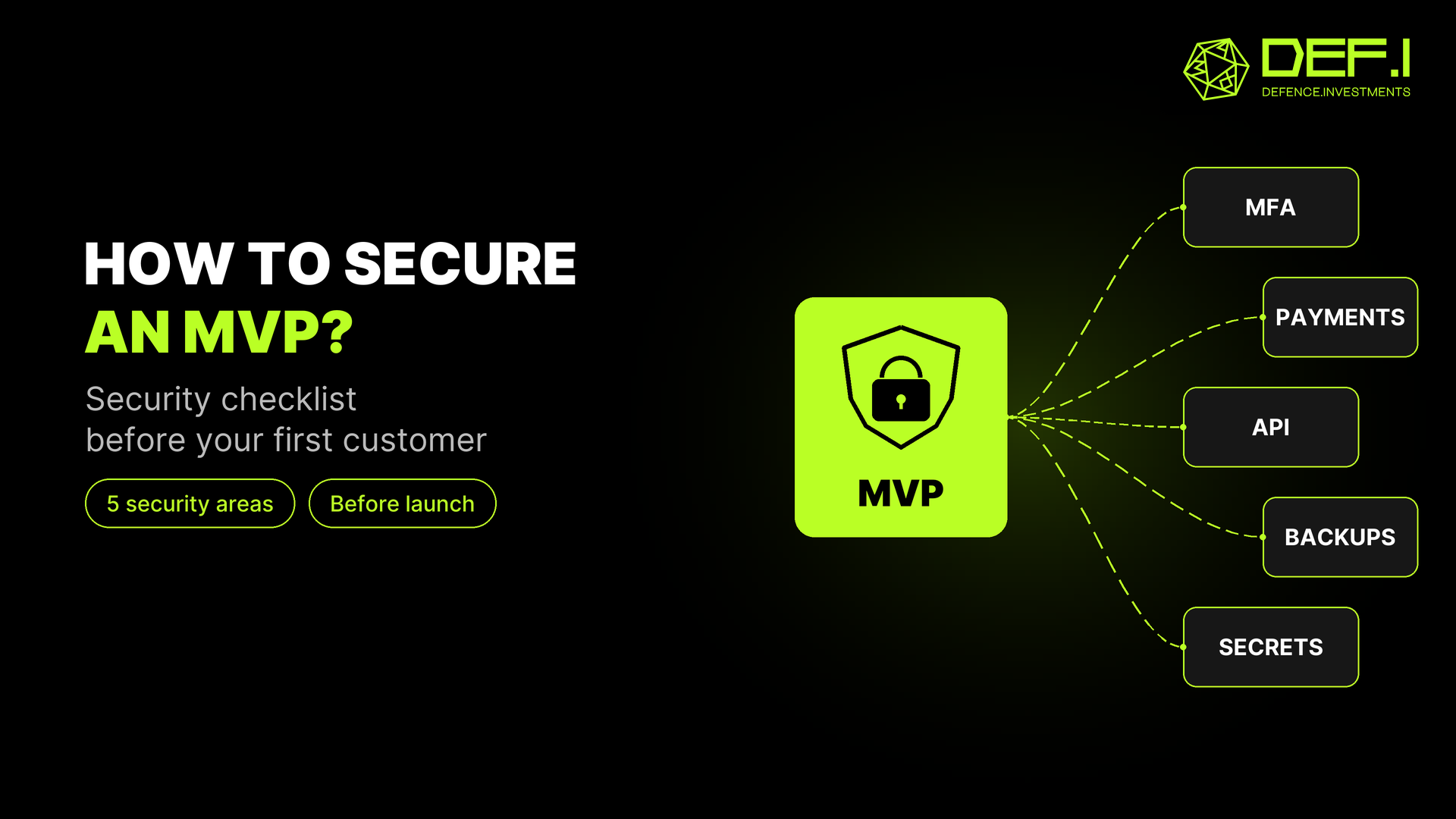
Five essential areas of MVP security: a pre-launch checklist
Identify critical features, data and access permissions. Start with five essential areas.
1. Authentication and account protection (MFA, bcrypt, brute-force protection and credential stuffing)
Credential stuffing occurs when attackers try previously compromised username and password combinations.
Enable multi-factor authentication (MFA) for administrators. Consider additional confirmation for sensitive user actions.
Store passwords as strong password hashes. OWASP recommends Argon2id for new applications. Bcrypt remains an option for legacy systems; choose a cost factor such as 12 after testing performance.
Limit login attempts. Five attempts per minute can serve as an initial configuration. Account for both account-level and IP-based activity, temporary delays and secure account recovery.
Verify permissions on the server. Regular users must not gain access to administrative features or other users' data.
2. Server-side payment verification, card tokenization and PCI DSS compliance
The backend determines payment status using confirmation from the payment provider.
Verify the authenticity of each webhook according to your provider's documentation. For example, YooKassa supports verification of an object's status via API or verification of the notification source. Match the amount, currency and order.
Repeated events must not result in duplicate balance credits. Use a transaction identifier and idempotent processing. Logs preserve transaction histories.
Use a secure payment gateway form. The application receives a token or payment method identifier. This can reduce PCI DSS scope, but applicable requirements must be assessed separately.
PCI DSS concerns payment card data security. Anti-money laundering (AML) and counter-terrorist financing (CTF) requirements depend on the jurisdiction and the entity's regulated activities. Confirm applicable retention periods with a qualified legal specialist. For example, Article 7 of Russia's Federal Law No. 115-FZ specifies a minimum five-year retention period after the end of customer relations for certain records held by entities subject to the relevant provisions.
3. API security, rate limiting and DDoS protection
The API receives application requests. Rate limiting restricts their frequency.
Configure limits by user, IP address and operation. Login attempts, SMS requests and payments require different thresholds. When a limit is exceeded, the server may return HTTP 429.
Complement rate limiting with request body validation: field types, required fields and size limits. Use parameterized database queries and verify permissions.
DDoS protection requires network-level and infrastructure-level controls. For public-facing products, consider a CDN, web application firewall and hosting provider protections. Rate limiting alone cannot prevent every attack.
4. Isolated backups and recovery testing
Enable automatic backups of the database and important files.
Store copies in a separate account or tenant. A production server account must not have permission to delete all backups. Restrict access.
Define the recovery point objective (RPO) and recovery time objective (RTO). Daily backups can mean losing up to 24 hours of changes.
Restore a backup in an isolated environment before release. Check data integrity. Repeat recovery tests regularly, after significant changes and at least once a year if the configuration remains unchanged.
5. Secure storage of secrets, API keys and environment variables (.env, .gitignore, commit history)
Secrets include API keys, tokens and database passwords. Exposed secrets can be used by unauthorized parties.
Keep secrets outside the source code. For local development, protect the .env file and exclude it using .gitignore. Prefer centralized secrets management in production.
Check commit history, including old branches. If a key has been exposed in a public repository, revoke it immediately. Review logs and clean the repository history if necessary.
Separate development and production secrets. Restrict employee and agent permissions. Use short-lived tokens where possible.
Enable secret scanning in Git and review CI/CD output.
Common startup security mistakes, including AI-assisted development
Cursor, Claude Code and other AI tools can accelerate development. The team must review generated code before release.
Check for five common mistakes before launch:
- API keys and tokens are exposed on GitHub, including in commit history.
- The API accepts request bodies without type validation or authorization.
- Payment status changes based on frontend data without provider confirmation.
- Test and production environments share the same secrets.
- Employees and AI agents receive excessive permissions.
Assign owners for remediation. Fix critical vulnerabilities before onboarding the first customer.
Legal requirements and personal data protection (privacy policy and logging)
Identify the lawful grounds for processing personal data. Account for applicable privacy, localization, notification and security requirements in the jurisdictions where the product operates. Depending on the circumstances, this may include the GDPR and Russia's Federal Law No. 152-FZ.
Document the purposes and categories of processing. Prepare a privacy policy and a process for exercising data subject rights. Consult a legal specialist on the documents.
Logs should record the time, identifier, type and outcome of each operation. Exclude passwords, card details and secrets.
Account deletion must respect mandatory retention periods. Limit how retained information is used and delete it after the retention period ends.
Assign responsibility for personal data protection. In the event of a data breach, follow the incident response plan and applicable notification requirements.
Step-by-step MVP security review before release and scaling
Start the review now to avoid losing months of work. For an MVP with payments, allocate time for dedicated test scenarios.
- Document data, roles and external connections.
- Test authentication and permissions using controlled accounts.
- Verify server-side payment handling, cancellations and repeated notifications.
- Configure rate limiting and test permitted request rates.
- Review secrets storage, the repository and production settings.
- Restore a backup in a test environment.
- Assign ownership of monitoring and vulnerability remediation.
Create a security checklist with verifiable release criteria.
| Area | Readiness criteria |
|---|---|
| Accounts | MFA for administrators, password hashing and role checks |
| Payments | Authenticity verified; repeated events do not create duplicate credits |
| API | Input validation, rate limits and authorization |
| Backups | Isolated copies and a successful recovery test |
| Secrets | Absent from source code and exposed history; access restricted |
| Data | Documented purposes, lawful grounds, retention periods and deletion procedures |
| Incidents | Assigned owner, available logs and an incident response plan |
Verify the results in a test environment. Monitor suspicious events after launch. Repeat the review when adding payments, roles or integrations.
For payment testing, prepare orders with different outcomes: successful payments, declined payments, refunds and repeated notifications. Users should see statuses confirmed by the server. For backups, record the date of the last successful recovery and the time it took.
When an exposed secret is discovered, determine which systems it could access. Preserve investigation logs and inspect other keys. Prioritize remediation by potential impact and likelihood of exploitation.
Frequently asked questions about MVP security
Is a separate security audit necessary before the first release?
It depends on the risk. Independent testing is a sensible precaution for financial products.
Can an MVP store bank card data?
It is simpler to use a payment gateway form and retain an authorized token. Confirm applicable PCI DSS requirements with your provider.
How much does basic security cost?
The cost depends on features and architecture. Include security in the development estimate from the first day.
Should passwords and keys be changed every year?
Rotate secrets according to risk and applicable requirements. Revoke them immediately if compromised.
Is automated code review sufficient?
Automated tools detect some issues. Business logic, permissions and financial scenarios require manual analysis.
Who is responsible for security in a startup?
Distribute responsibilities among the product owner, developers and infrastructure team. Providers are responsible within the scope of their contracts.
Defence.Investments offers turnkey MVP development, taking business logic, architecture and agreed security requirements into account.
 0
 2




 November 3, 2026


















Comments 0