
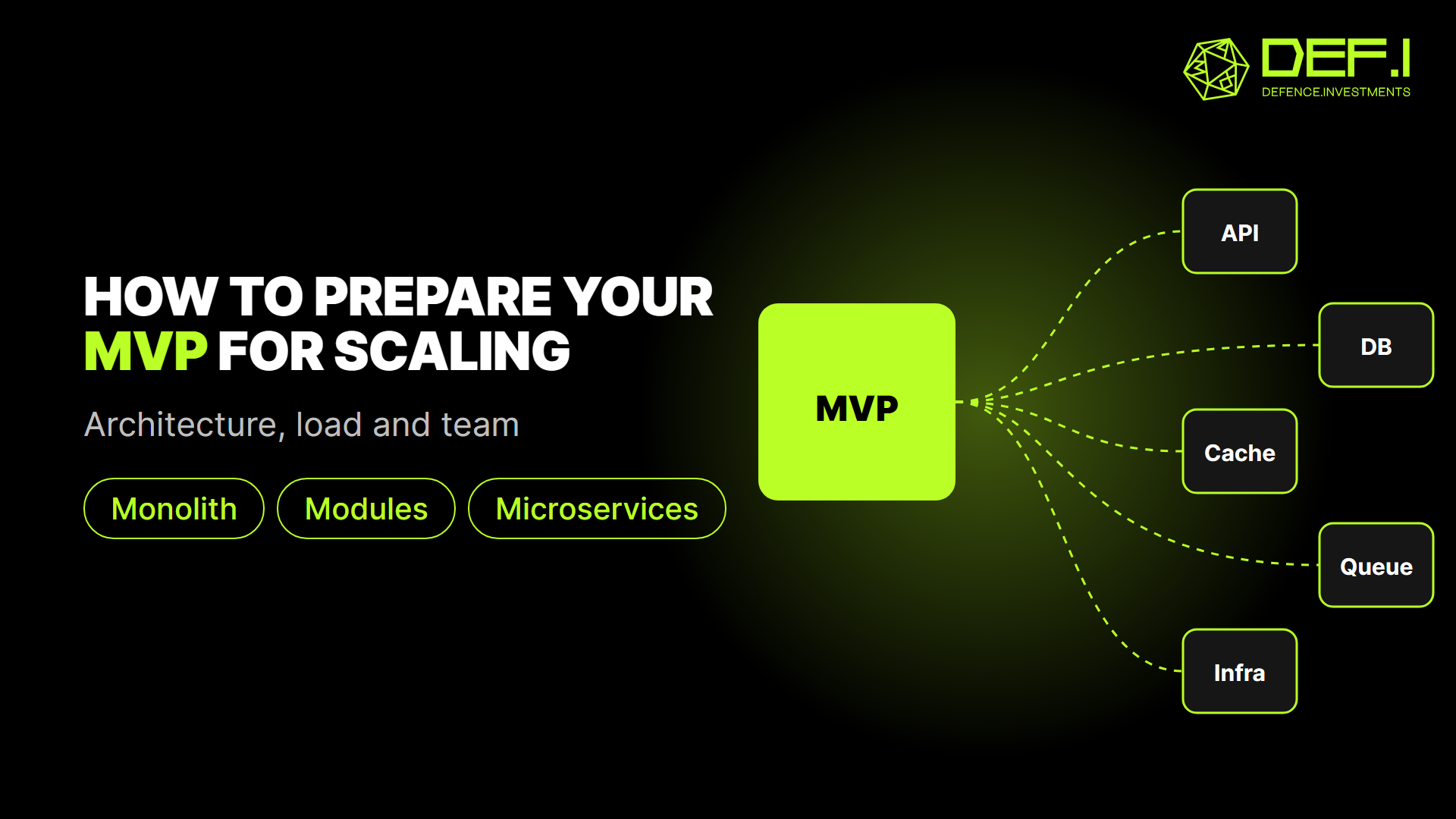
How to Prepare an MVP for Scaling: Architecture, Load and Team
Contents
Scaling starts with checking demand, metrics and architecture. This article covers readiness signs, a work plan, load benchmarks and a list of common mistakes. If you do not have a working version yet, start with turnkey MVP development.
What it means to scale an MVP
Scaling means growing a project without losing speed or quality. The audience, the volume of information, the feature set and the staff all increase. The service must handle more requests, and the cost of serving one customer must not rise.
Audience growth and scaling are separate tasks. Marketing brings people in. Scaling lets the platform, the processes and the specialists cope with that flow. If traffic grows and the service goes down, you have not scaled.
Users judge scaling by speed and stability. They care whether a page opens within a second and whether a payment goes through on the first attempt. So define scaling goals through user experience: response time, availability and error rate.
Scaling an MVP touches architecture, infrastructure, processes and the revenue model. The project owner must know what each new customer costs. If scaling makes the project unprofitable, stop and recalculate the economics.
An MVP is built to test a hypothesis. It has a minimum of features and is often written fast. Such a solution is rarely designed for heavy load, so the move from a trial version to growth needs separate preparation.
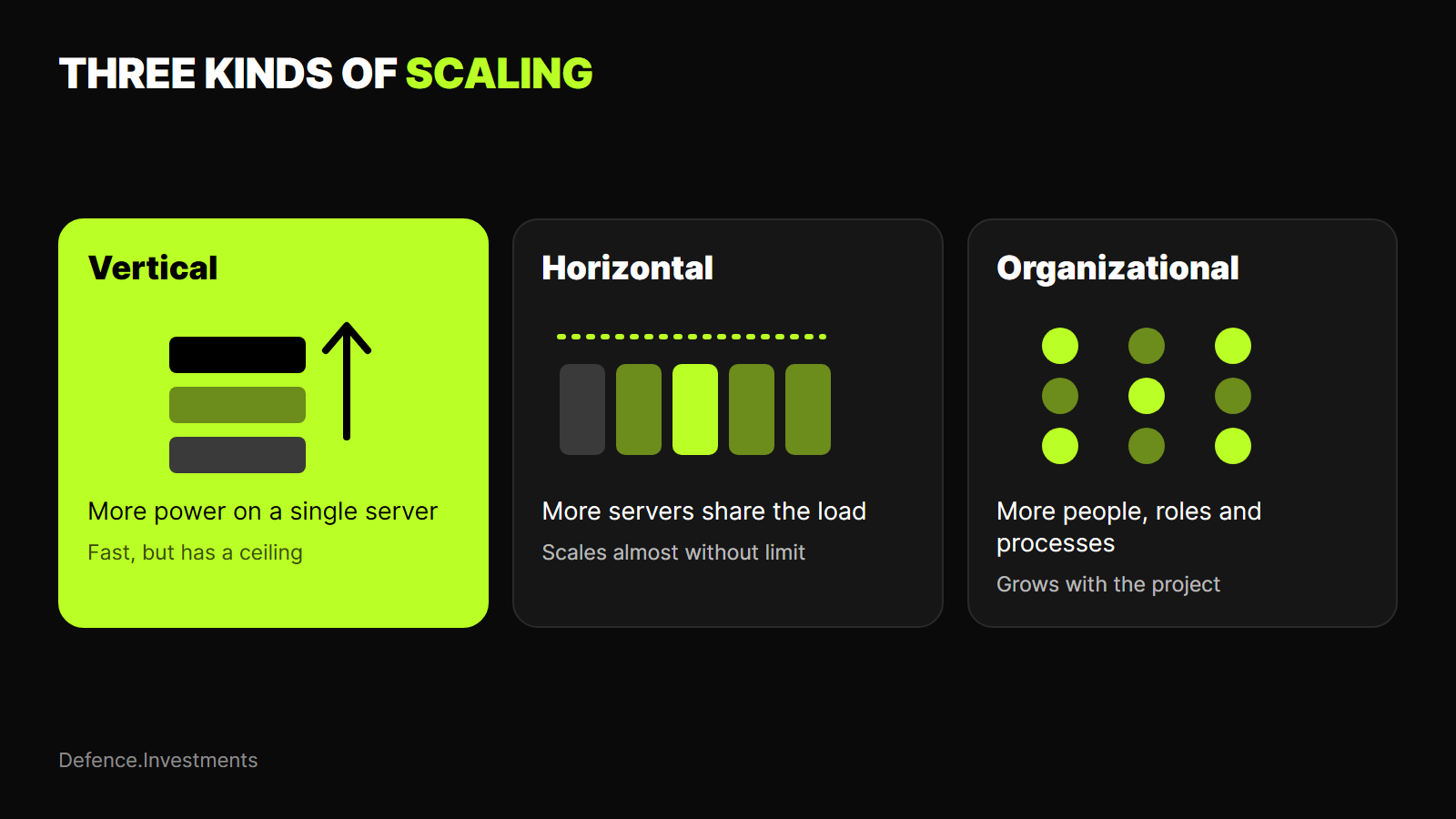
There are three kinds of scaling:
- vertical: more power on a single server;
- horizontal: more servers that share the load;
- organizational: more people, roles and agreed processes.
Most teams start with the vertical option because it is faster. It has a ceiling, since one server's power is finite. For further growth the platform moves to a horizontal scheme.
Signs that your MVP is ready to scale
Scale only what has already proven its value. If demand is unconfirmed, server costs will only deepen losses. First make sure the hypothesis works.
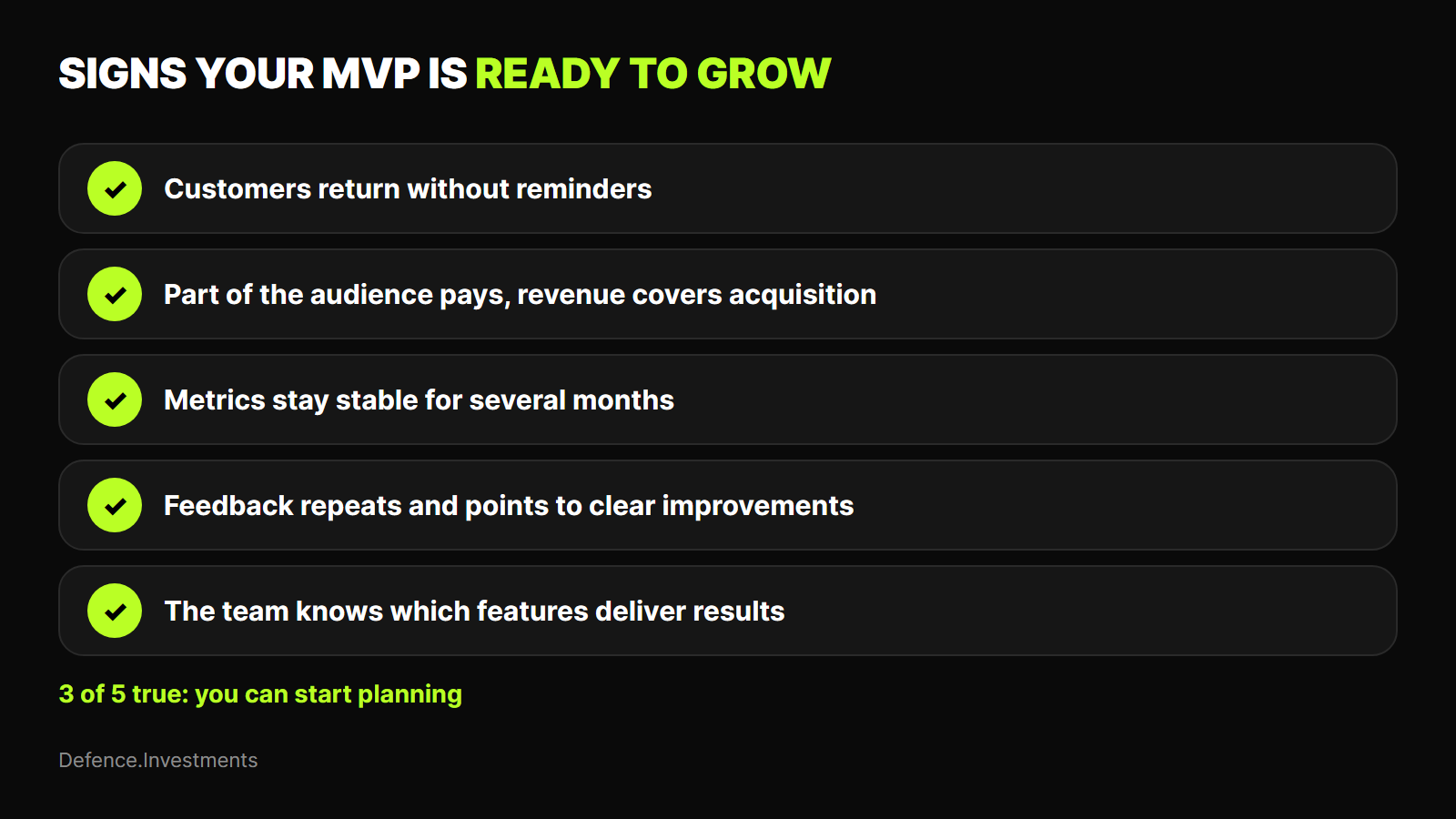
Five signs confirm readiness:
- Customers come back without extra reminders.
- Part of the audience pays, and revenue covers acquisition costs.
- Key metrics stay stable for several months in a row.
- Feedback repeats and points to clear directions for improvement.
- The team knows which features deliver results and which get ignored.
If three of the five are true, you can start planning. If only one or two are, go back to hypothesis testing. Decide in advance which metric will signal the start of the work.
Look at features separately. Find out which features users rely on most. Many users never reach half of what the first version offers. Add new features only after that analysis. Every extra feature raises support costs and slows development.
Technical signals matter too. Pages open slower than before. Calls to the storage layer take seconds. Developers spend more time on fixes than on new work. These symptoms show that the current structure is near its limit.
How to tell that your architecture will not survive growth
Architecture is the layout of a platform: how components connect and where records are kept. In a first version it is built for launch speed. For the first few hundred customers that is enough. As load grows, the weak spots show up fast.
Three questions test your margin. How many simultaneous visitors can the platform handle today? What happens if load grows tenfold? How many days does one change take to ship? If you have no answers, start with an audit.
Technical debt and bottlenecks in the code
Technical debt is the accumulation of shortcuts in the software. Specialists pick a quick solution over the right one to make the launch date. While the service is small, the debt is almost invisible. As the audience grows, it slows changes and raises the risk of outages.
Bottlenecks limit the performance of the whole platform. The most common ones are:
- slow queries to the storage layer;
- missing caching;
- heavy operations that run during the customer's own request;
- blocks that cannot be tested in isolation;
- tight coupling between modules.
Find these spots before customers do. Use profiling and monitoring: they show which operations take the most time.
How to audit the codebase
An engineer who did not write this part of the system should run the audit. A fresh view finds problems faster. The work takes from a few days to two weeks, depending on the size of the project.
The steps look like this:
- Describe the architecture: modules, services, storage, external integrations.
- Run static analysis and collect the list of findings.
- Check whether tests cover the critical scenarios.
- Find the slowest operations.
- Assess security: access control, password storage, API protection.
- Write a prioritized list of problems with effort estimates.
The result is a document with recommendations. It helps you decide what to fix now and what to postpone. The same document feeds the budget and timeline estimate.
Refactoring or rewriting from scratch: how to choose
After the audit one main question remains. Do you improve the existing solution or build a new one? The answer depends on the state of the project and the goals of the business.
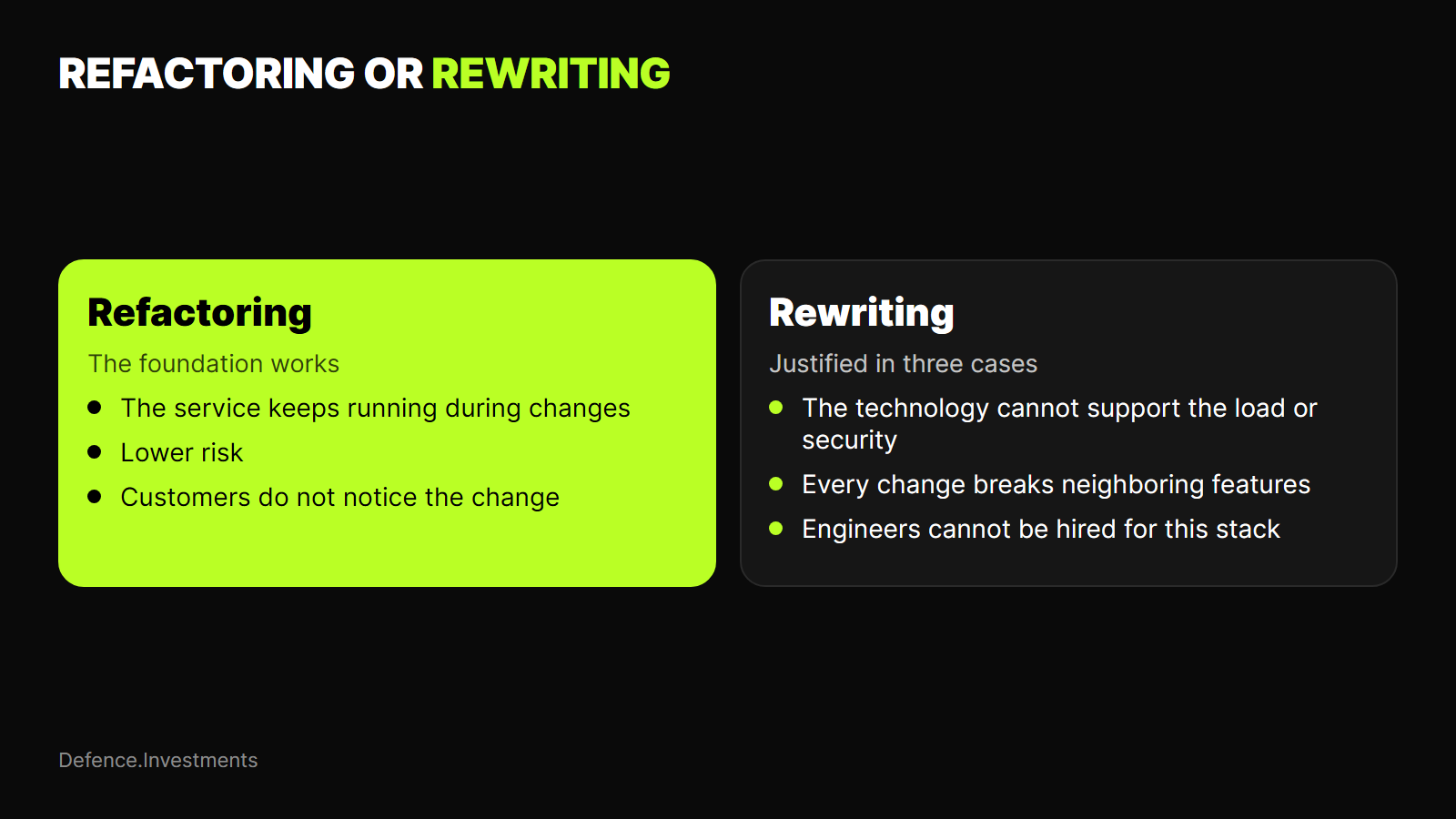
Refactoring changes the internal structure without changing behavior. The service keeps running while specialists improve it piece by piece. Risk is lower, and customers do not notice the change. This path fits when the foundation works.
A rewrite replaces the solution entirely. It takes longer and costs more. During that time the platform gets no improvements, and the specialists may repeat earlier mistakes. For that reason a full replacement is rarely justified.
Rewrite in three cases:
- the chosen technology cannot support the required load or security requirements;
- the structure is so tangled that every change breaks neighboring features;
- engineers cannot be hired for this stack.
In all other cases choose refactoring. Refactoring is safer with tests in place. Testing critical scenarios protects against regressions. If you have no automated tests yet, add them before changing the code.
The safest approach is to isolate problem modules and replace them one at a time. The rest of the platform keeps running.
How to design a product for 100,000 users
An audience of 100,000 customers changes the requirements for infrastructure. Traffic peaks appear, the volume of information grows, and you depend on external services. The solution must handle this without a rewrite at every stage.
Leave headroom in capacity. At first it is enough to handle two to three times the current load. Review the forecast every few months and update the plan. That way the product grows without sudden rebuilds.
There is no universal scheme, because load depends on the type of service. A chat, an online store and a financial platform behave differently. The basic principles are the same: separate responsibilities, remove single points of failure and measure the result.
Modular monolith and the move to microservices
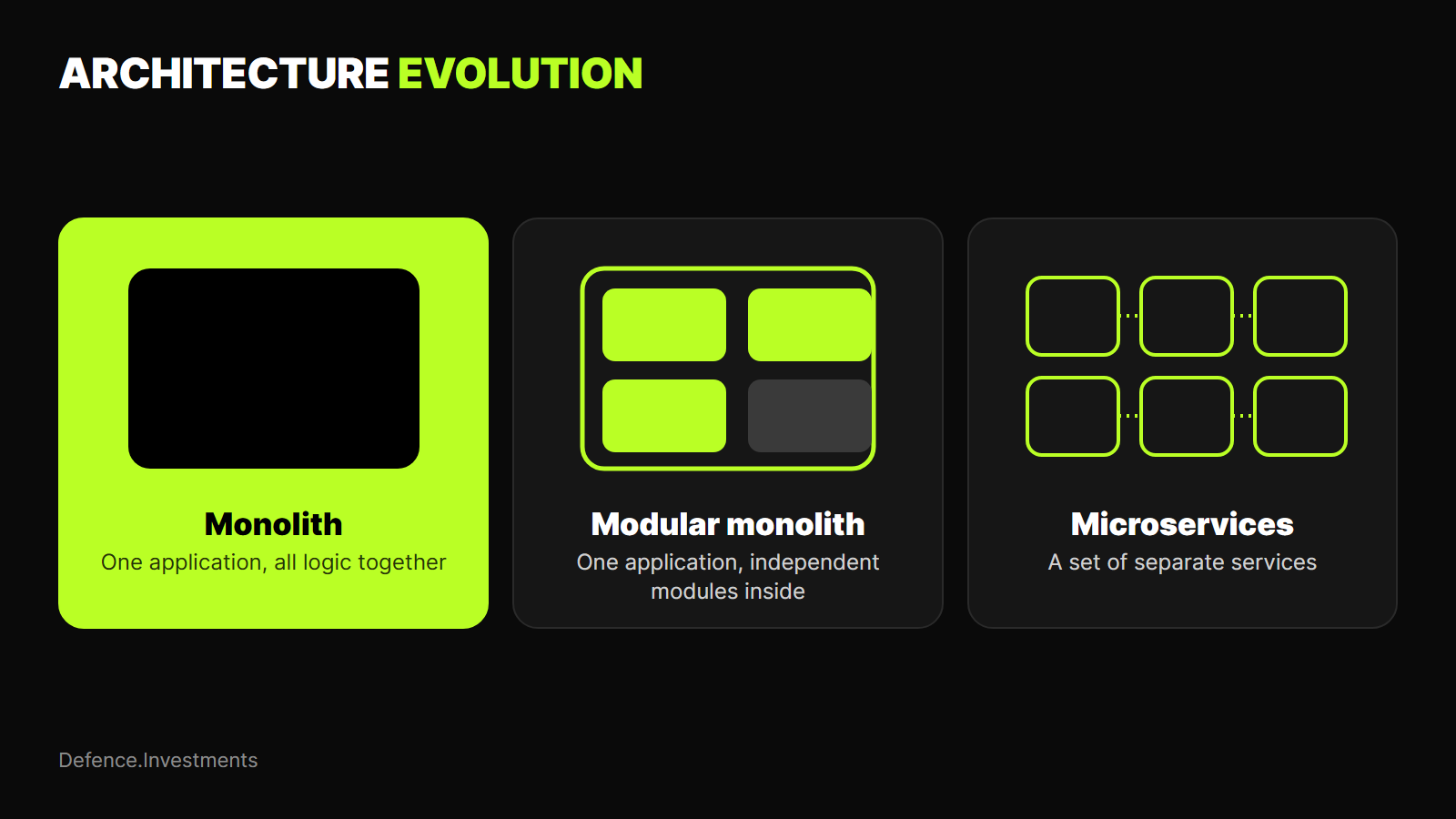
A monolith is an application where all the logic runs as one unit. For a first version this is a convenient option: it is easier to build and release. Problems begin when the logic grows and modules depend on each other.
A modular monolith is the intermediate step. The application stays single, but inside it splits into independent modules with clear boundaries. Each module owns one area: payments, profiles, notifications. Such a structure is easier to develop and to split into services later.
Microservices are a set of small services, each running separately. They let you add capacity only for the heavily loaded parts. The price is high: releases, monitoring and coordination between services get harder.
Move to microservices when several conditions hold. Several groups of specialists work on the project. Parts of the platform carry uneven load. You have experience running distributed services. Without these conditions, a modular monolith remains a sensible choice.
APIs and integrations with external services
An API is the interface programs use to exchange messages. As the audience grows, more calls go through it. External services such as payment systems and email providers become part of your reliability.
A few simple rules apply to external integrations:
- set a timeout on every external call;
- retry failed calls with a growing pause;
- move long operations into a task queue;
- limit call frequency to protect against overload;
- version your API so changes do not break client applications.
First measure the number of requests per second at peak hours. Those requests show the real load. Then find the requests that cause the most delay. Optimize them first.
These measures reduce the effect of other people's outages on your service. If a payment provider responds slowly, customers still see a working interface.
Scaling the database
The database is usually the first component to reach its limit. Every customer call converges on one point, so optimize it first.
The basic techniques go in this order. First add indexes on the fields used for search and sorting. Then speed up the slow queries found by the audit. After that connect read replicas, which take over reports. When that is not enough, split the records between servers by a key, such as the customer number.
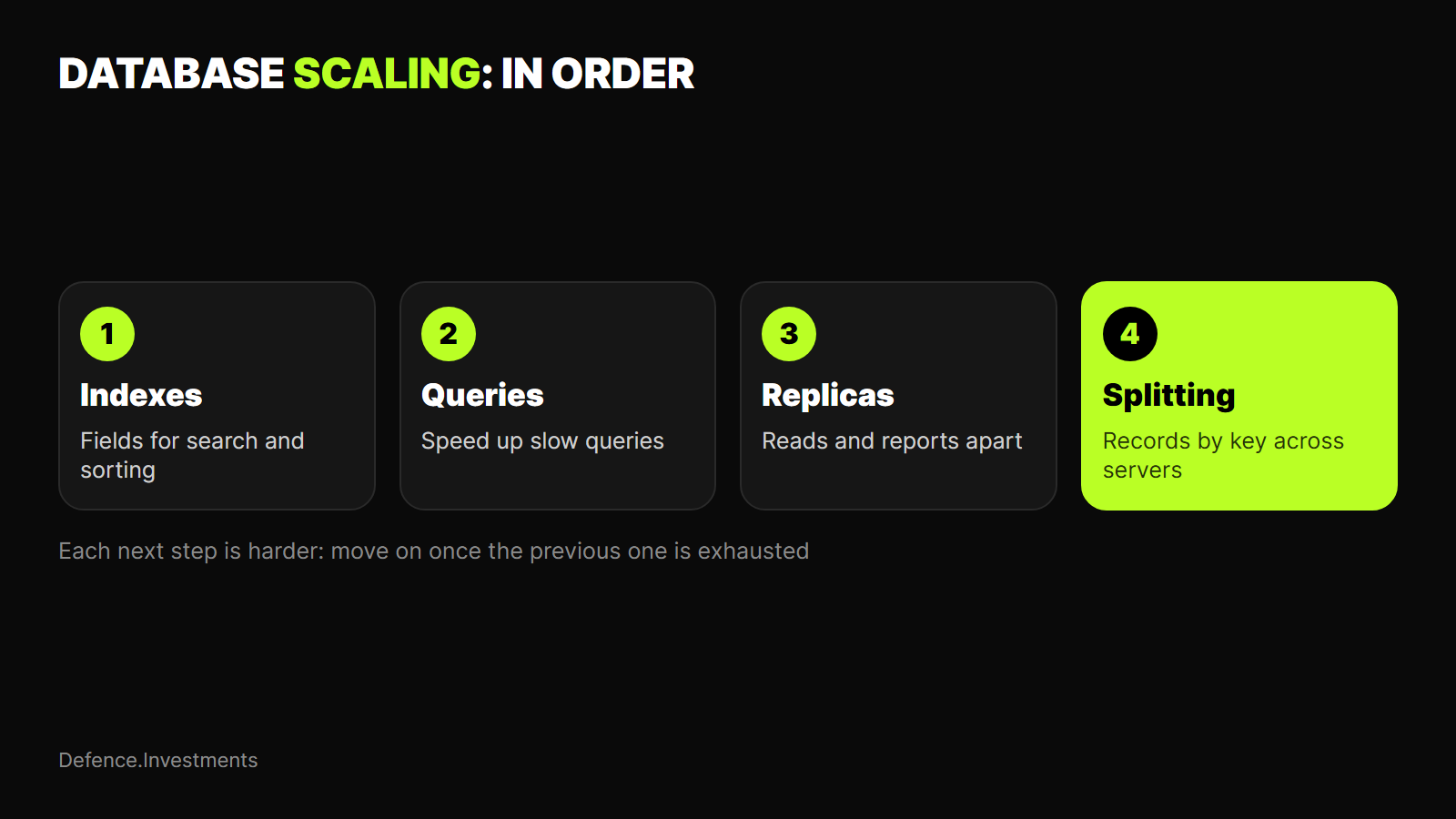
Each technique makes the setup more complex. Move to the next one only after the previous one is exhausted. Check in advance how schema changes affect the running service: they must not stop the application.
Cloud infrastructure, caching and autoscaling
Cloud platforms such as AWS and Google Cloud let you add resources as needed. You do not have to buy hardware in advance. You pay for what you use.
Caching stores the results of frequent operations in fast memory. The application does not go back to the database and responds faster. Teams cache reference tables, profiles and the results of heavy calculations. For static files, use a content delivery network that serves them from the server nearest to the visitor.
Describe infrastructure as code. This approach is called Infrastructure as Code. The configuration lives in a repository, and the environment is deployed with one command. It speeds up scaling and reduces mistakes.
Autoscaling adds servers when load increases and removes them when it falls. For that, the application must not keep state on a single server. Sessions and files move to external storage. Then any server can handle any call.
Load testing and performance monitoring
A load test shows how the platform behaves as traffic increases. You create artificial load and watch where delays and errors appear. This finds problems before real customers meet them.
Tools such as k6, Locust and JMeter work well here. They simulate thousands of simultaneous visitors. Take scenarios from real actions: sign-in, search, payment. Run the checks in an environment that mirrors production.
A load check runs in several stages:
- Define the target load from the growth plan.
- Run the test with a gradually increasing number of visitors.
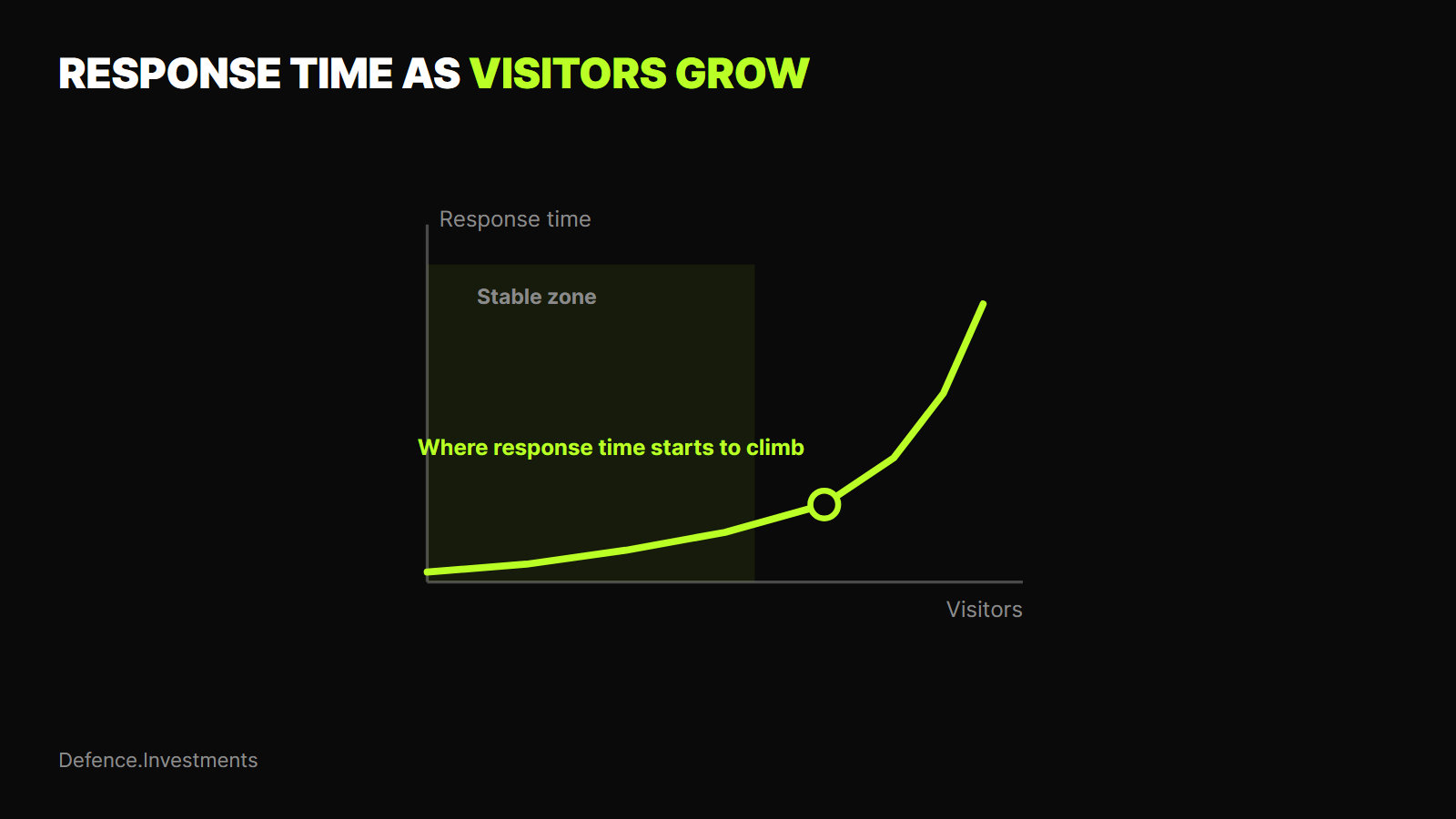
- Record the point where response time starts to climb.
- Find the cause: the database, the application server or an external service.
- Fix the problem and repeat the test.
Monitoring runs continuously, including after launch. It collects response time, error count, processor and memory load. Prometheus, Grafana and Sentry are suitable tools. Set up alerts so specialists learn about a problem before customers do.
Watch the p95 response time. It shows how long 95% of calls wait. The average hides slow cases, while p95 shows them.
Metrics and analytics to collect before scaling
Without numbers, growth decisions are guesses. Metrics show what works and what does not. Collect them in advance so you have a baseline.
These indicators describe audience behavior:
- retention: how many customers return after a day, a week, a month;
- activity: the number of active customers per day and per month;
- conversion: the share of visitors who reach the target action;
- churn: the share of customers who left during the period.
Financial metrics show the economics of growth. They include customer acquisition cost, revenue per customer and payback period. If acquiring a customer costs more than the customer brings in, growth will increase losses.
Technical metrics describe the state of the system: response time, error rate, availability. Set a target value for each and check it regularly.
Collect data for at least three months. A short period gives random results. Over several months you see seasonality and real user behavior. Count metrics separately for new and returning users.
Set up analytics in advance. Connect an event tracking tool and a single source of figures. After growth starts, you can compare results with the baseline and see what made the difference.
The team at the growth stage: who to hire
The staff at the start is usually small. A few developers cover the whole stack, and one person handles both priorities and analytics. As load grows, this setup stops working.
Add the following roles as needed:
- a technical lead owns architecture and technology choices;
- a DevOps engineer sets up infrastructure, releases and monitoring;
- a QA specialist checks quality before every release;
- a project manager sets priorities and connects the owners with development;
- an analyst works with metrics and hypotheses;
- support answers customers and collects feedback.
The team grows in stages. The first period goes to the audit and fixing weak spots. Then the team works on new features and rising load. Assign someone responsible for technical quality, otherwise the team keeps switching between tasks.
Hire for a specific problem. If outages increase, you need DevOps. If changes ship slowly, you need a technical lead. Expand the staff as tasks appear.
Another option is to bring in an external group. It joins quickly and fills the missing roles. Defence.Investments offers turnkey startup development and supports the project after launch. More than 10 years, 30+ specialists, 100+ completed projects.
Step-by-step plan for preparing an MVP for scaling
The plan walks you through the path in order. Timing depends on project size and platform state, so rely on your own numbers.
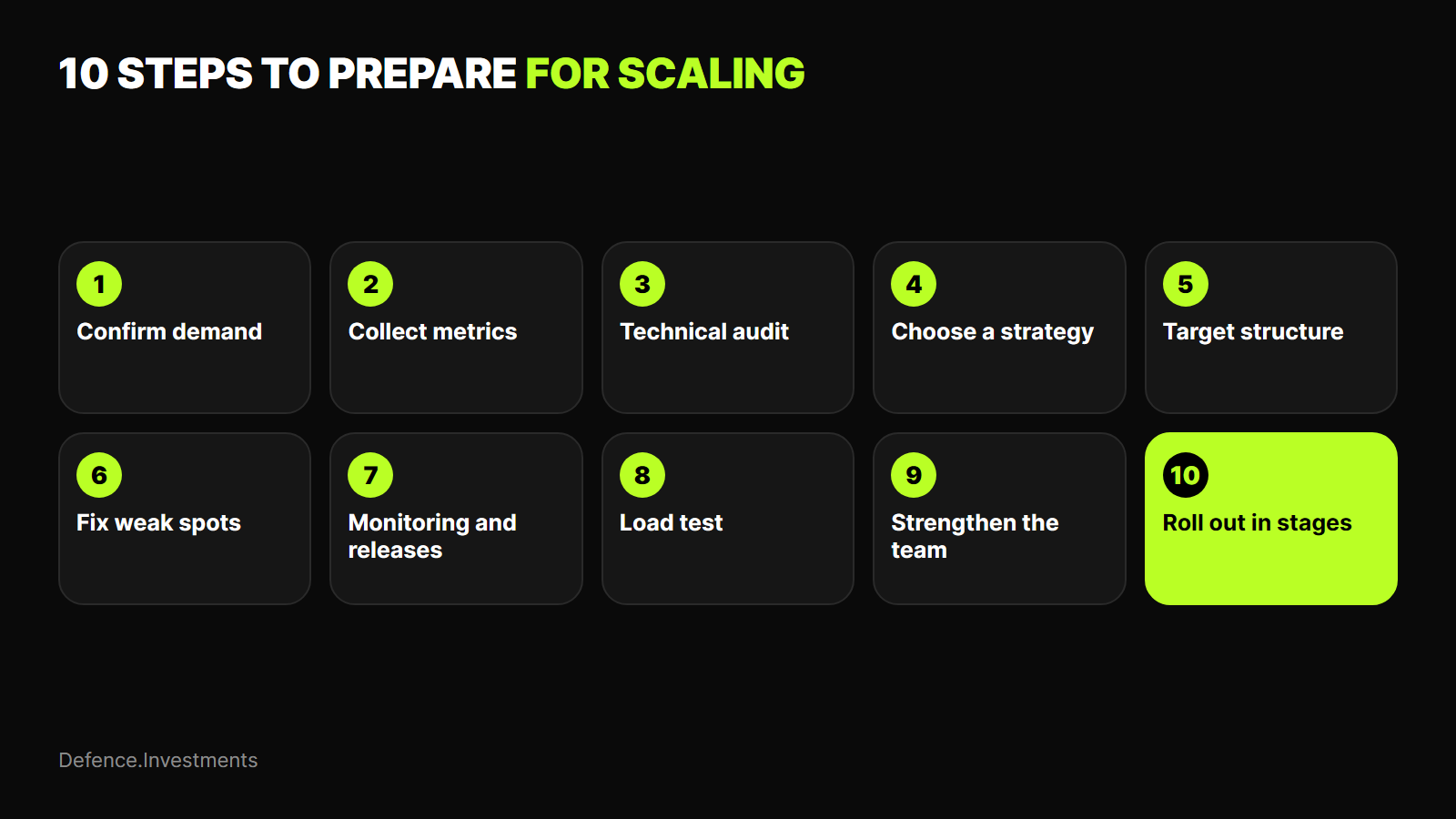
- Confirm demand: check retention, payments and recurring feedback.
- Collect metrics: set up analytics and record baseline values.
- Run a technical audit: find weak spots and write a prioritized list.
- Choose a strategy: refactoring, module replacement or a rewrite.
- Design the target structure: describe modules, database, cache and cloud resources for the expected load.
- Fix the weak spots, starting with the database and the slowest operations.
- Set up monitoring and automated releases: connect alerts.
- Run a load test at the target load.
- Strengthen the staff: add the missing roles.
- Roll out growth in stages: increase traffic in parts and watch the metrics.
For a small project, the guideline looks like this. The first month goes to metrics and the audit. The second and third months go to fixing weak spots. The fourth month covers the load test and a staged launch. Real timing depends on the project.
Each stage produces a result you can check. If metrics get worse at some step, stop and find the cause. That way you keep what you have already built.
How much it costs to scale an MVP
There is no single price. Cost depends on project size, the state of the architecture and the target load. Two systems with the same audience can need very different amounts of work.
The budget depends on these factors:
- the audit result and the volume of problems found;
- the chosen strategy: refactoring costs less than a rewrite;
- the target load and availability requirements;
- the cost of cloud resources and service licenses;
- the size and composition of the staff;
- security and regulatory requirements.
Plan cloud spending separately. It grows with load and continues after launch. Keep a reserve for unplanned work: an audit almost always finds extra tasks.
A project audit gives the exact estimate. Defence.Investments assesses a project free of charge. Cost and timeline are fixed before the work starts.
Scaling specifics for fintech products
Fintech services handle money and personal information, so they face extra requirements. A calculation error or a leak costs more than in an ordinary application.
Pay attention to the following:
- Transaction integrity. Every operation completes fully or does not run at all. Use database transactions and duplicate checks.
- Security. Encrypt information at rest and in transit, restrict access and keep an action log.
- Customer verification. KYC and AML procedures must handle a growing number of registrations.
- Reporting and audit. The platform stores the history of operations and provides it on request.
- Regulatory requirements. They depend on the country and the type of activity, so confirm them with qualified lawyers.
Users of fintech products are especially sensitive to outages. A transfer delayed by a few minutes triggers support requests. So the availability of payment features comes first.
Run the load test of a fintech service on scenarios with payments. Check the behavior when a payment provider fails. The Defence.Investments team helps with the technical side, and qualified lawyers handle legal questions.
Common mistakes when scaling an MVP
Most problems repeat from project to project. Knowing the typical mistakes helps you avoid them.
The most frequent ones:
- Scaling before demand is confirmed. Money goes to servers for customers who do not exist yet.
- Premature microservices. The complexity arrives immediately and the benefit comes later.
- A full rewrite without need. The project freezes for months while competitors move ahead.
- No metrics. You cannot tell whether the changes helped.
- Postponing database work. It gets optimized last, although problems start there.
- Load tests on unrealistic scenarios. The result differs from the production situation.
- Ignoring user feedback. New features appear while old problems remain.
- No rollback plan. A failed release leads to long downtime.
You can prevent any of these mistakes more easily than you can fix them. Before each stage, ask which data supports the decision. If there is no answer, collect facts and only then move to the next step.
Most mistakes come down to the order of actions. Demand and figures first, then architecture, then growth.
Questions and answers
When should you start scaling an MVP?
Start when the project has proven its value. Customers return, some of them pay, and metrics are stable. Technical preparation can begin earlier, several months before the expected growth. Then the platform is ready when the load arrives.
Do you need to rewrite the MVP from scratch?
Usually no. Refactoring in parts is safer and cheaper. The service keeps running while specialists improve the most problematic modules. A rewrite is justified if the technology does not fit or the solution cannot be developed further.
How long does preparation for scaling take?
The time depends on project size and platform state. The audit takes from a few days to two weeks. Fixing weak spots and setting up infrastructure takes from one month to several. The exact timeline is given after the audit.
When should you move to microservices?
Move when several groups work on the project and load on parts of the platform is uneven. You also need experience running distributed services. Without these conditions, a modular monolith will do.
What load should the project handle?
Set the target load from the growth plan. Take the expected audience and add a reserve for peak periods. Then verify the result with a load test. There is no universal figure, because it depends on the service.
Can you scale an MVP without your own development team?
Yes. An external group can do the audit, the architecture and the implementation. Give it the metrics and clear goals. After launch you still need someone in your company who owns the priorities.
 0
 1




 October 20, 2026
















Comments 0