
Fund Manager and Investor Relationship: Fees, NAV and LPA
Contents
Investing is always discussed through numbers: returns, risk, horizon, rate. But there is one thing numbers cannot describe - the relationship between the manager and the investor. It is most often what decides how the story ends. Not the market, not the strategy, not the economy - people.
It Is Like a Marriage, Only Longer
If you put money into a closed fund or agreed to a long-term placement with a manager, you have committed to coexist with this person or structure for five to fifteen years.
Five years. In that time people change their views, their beliefs, their outlook, their families. Imagine ten or fifteen. And all that time you will have to resolve business and financial questions - including conflicts, including uncomfortable ones, including those when the money has run out and both sides are nervous.
That is why, when choosing a manager or an investor, you should look at more than the strategy and the traction. You should look at the person. You will live through the whole range of emotions with them - joy over results, stress over losses, irritation from misunderstanding, relief at exit.
Without readiness for this long-term coexistence, any beautiful numbers in a presentation lose their meaning.
Why Interests Diverge
At first glance, the manager and the investor want the same thing: to earn money. But they earn on different things.
A simple example: a personal manager at a brokerage who receives a percentage of the client's profit. It seems that sounds good and their interest matches yours. In practice, their risks and yours are different. If they make a bad trade, they get a reprimand and a ruined day. You get a loss. It is an unequal exchange. That is why their goal is to open as many trades as possible and take risks - because it is not their money at risk.
The profit is shared, and the loss is yours.
In venture funds the picture is more complex, but the logic is the same. It benefits a managing partner to show a high portfolio valuation - it attracts new money, confirms their competence and secures the management fee. For the investor, what matters is real cash in hand - what they can withdraw and spend.
These goals overlap, but they do not coincide. And conflicts are born exactly in the zone where they differ.
Management Fee vs Success Fee: The Fundamental Problem
Every fund has two main sources of income, and both create contradictions.
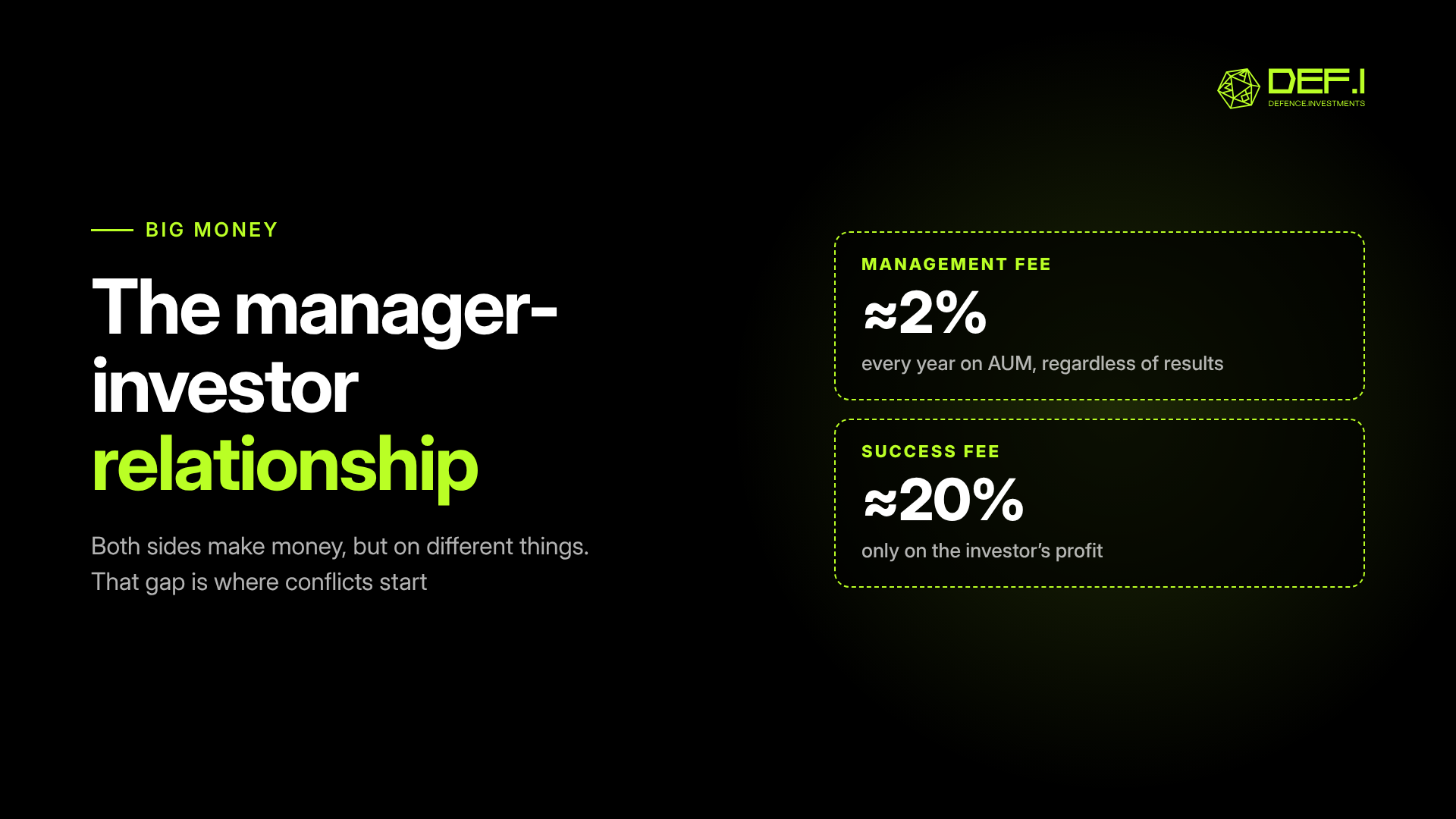
Management fee - the fee for managing the fund - is charged annually on the total amount of assets regardless of results. The standard for large funds is around 2%. For small ones it is 5% and above. The fund receives this money always: whether the investor earned or not.
This creates a strange mechanic. The manager benefits from growing AUM - assets under management. More money means more management fee. There was a real case: a fund with a management fee of 7-8% made not a single deal in three years. In that time about 24% of the investors' capital was consumed. The money was gone, and there were no deals.
Success fee - a percentage of profit - the standard is around 20% of the profit. It aligns interests: the manager earns only when the investor earns. But if the success fee is the only income, another problem arises: with a bad portfolio, the manager starts taking bigger risks. They have nothing to lose in terms of fixed earnings, and betting on a risky deal with high potential seems like a logical way out. This is one of the paths to a possible catastrophe.
A well-built fund balances both instruments. On top of that come the hurdle rate (the minimum return threshold for the success fee), options for managers on project shares and other mechanisms. The goal is to make the manager's and the investor's interests at least partly coincide.
In Western practice there are mathematical formulas for this. In the CIS it is more often built on informal understandings.
NAV: How to Value What You Cannot Sell
One of the main questions investors ask managers: why is the portfolio valued exactly this way?
NAV is net asset value, the value of the fund's net assets. If you invested 10 units of money and the fund bought assets that are now valued at 11, the NAV is 1.1. It sounds simple. In practice - it is not.
In venture and private equity funds, NAV is an estimated value, not a market value. There is no public exchange for startups where you can see the price in real time. The valuation is built on multiples, forecasts, comparative analysis - and largely on what could be called a "faith coefficient."
The "faith coefficient" is my own understanding of the process and my own term: most of the mathematical parameters are essentially hidden behind blind faith in... And there is always something of one's own there that one badly wants to believe.
The problem is that NAV bakes in possibilities, not reality. Possible profit, possible market growth, possible potential of the founder. All of it can come together beautifully. Or it may not come together at all.
That is why, on the secondary market - when investors want to exit early - fund shares are sold at a 30% discount to NAV. Professional participants understand that what is calculated in NAV and what it can actually be sold for are different things.
To see how subjective this is: there was a real case where one fund received four different NAV estimates from four different valuation companies. All professional, all following a methodology. All different.
The LP Agreement: What You Are Signing
The Limited Partner Agreement (LPA) is the founding document that governs the relationship between the fund and all of its investors.
If you are a manager creating a fund, you need to put everything into this document. It will define the life of the fund for years ahead.
If you are an investor joining an existing fund, the chance that the document will be amended for you is close to zero. Either you have a great deal of money and you are a very significant investor, or the fund is frankly weak. Those are the two options.
So the investor's task is to study carefully what is already written. The key things to look at: the ability to freeze deals or withdrawals, the conditions under which you can exit early, how investment decisions are made, and what happens in a conflict of interest.
An important practical point: if the manager has already spread the money across projects and a conflict arises, you will not be able to simply take your money back tomorrow. It is already in the projects. Projects do not return money on demand. If you fell out with the manager and the exit is not written down, the problem will have to be solved through negotiation. If that works, good. If not, the route is court, and that is long and expensive.
Always involve lawyers in drafting and reviewing such documents. Not ChatGPT, not templates from the internet. Real people who have seen what happens when such a document is badly written.
Large Investors and Hidden Democracy
If you think all investors in a fund are equal, that is not the case.
There are side letters - separate agreements between the fund and large LPs that give them special rights. Anything up to the right to close the fund by a qualified majority.
The largest investors often unite into an LP committee - an advisory body that discusses conflicts of interest, helps value the portfolio and gives recommendations. It is 3-7 of the most significant participants. They may be in several funds at once, which gives them a broader picture of the market than the manager has.
A small investor does not get into this committee. Their opinion usually interests no one - they have neither money nor influence. It is an unpleasant but honest reality.
A trend of recent years: LP investors are becoming more active. Previously an LP committee in a fund was considered a progressive practice. Today a fund without one looks archaic. Collegiality makes decision-making slower, but more reliable.
Reporting: What an Investor Should Receive
The standard is quarterly reporting. The main metric for the investor is DPI (Distribution to Paid-In): how much money has been received for every unit invested. Below one is a loss, one means you broke even, two is good, three is an outstanding result.
A practical risk rule: if the fund is high-risk and there is a chance of losing everything, do not invest more than you earn over an equal period of time. You can lose money only once - and rebuilding it will take as long as it took to save. And there is no guarantee you will have that time.
If the reporting is too thin - one line with a single total figure - ask for a breakdown. In normal organizations it is provided. Usually only banks do not give a breakdown, because they do not care about you much. Funds have a different kind of relationship.
But do not overdo it either. If the manager is busy preparing reports, they are not managing the money. Find a balance. One figure is too little, a hundred and thirty lines is already too much.
A separate warning sign: if there are no reports at all and at the same time there is an active referral program urging you to bring friends, you have probably invested in something problematic. Speaking plainly, most likely in some kind of scam. Referral programs exist in serious organizations too, but they look completely different: most often it is a small bonus for bringing an investor over from another fund, and definitely not the basis of fundraising.
Force Majeure: Know the Exit Before You Need It
The 2008 crisis is a real example of how markets stopped and funds froze withdrawals. Liquid assets were separated from illiquid ones, payouts were postponed, accounts were split.
This is not necessarily fraud. Funds, as a rule, have no interest in holding your money longer than necessary. Sometimes there is simply no liquidity - the money is in projects, and projects do not return money on demand.
Sometimes an investor receives an asset instead of cash. Straight into their hands - a share in a company or something real. That is also a workable outcome if the asset has a clear value to both sides.
The main thing to do in advance is to study which exit instruments your particular agreement provides. Gate provisions (limits on withdrawals), redemption lines (return thresholds at which you can take your money out), the procedure for liquidating assets. You need to know this before the problem arises - not during it.
When everything is fine, nobody argues. Conflicts come in bad times. If the rules of behavior for bad times have not been agreed in advance, bad times become truly bad. Rules agreed beforehand for a crisis are not pessimism - they are basic hygiene.
What Follows From This
The manager and investor relationship is a long-term contract between people, not only a legal document. Both want to earn, but the mechanics of how they earn are different. Conflicts are born exactly from that difference.
What helps:
- Understand how the manager earns and how that relates to your interests.
- Study agreements before signing - with lawyers, not with neural networks.
- Know your levers: voting rights, the ability to freeze, the redemption line.
- Agree on KPIs, follow-on rounds and exit conditions in advance, while the relationship is good.
- Read the reports and demand a breakdown if there is not enough detail.
- Know how to exit in a crisis before the crisis arrives.
Managing money is not a pure science and not pure mathematics. It is also people. And it is exactly where the mathematics ends that the real difficulties begin.
If you are a manager and want to give investors transparent reporting and a personal account, the Defence.Investments team builds investment platforms for asset managers.
 0
0 1
1
 October 13, 2026






Comments 0