
How Venture Funds Make Investment Decisions
Contents
Most people think that raising investment means writing a good presentation and finding the right email address. In reality, it is a long, draining process with several checkpoints, and at each one you can be turned down. Let's go through them in order.
Where Deals Come From: Networking as the Only Door
The first and most important fact: 60-70% of investment deals close through networking. Personal connections, reputation and referrals are what move money in the venture world.
Cold applications - where the fund and the project did not know each other before the approach - make up 1-2% of all closed deals. Not of the applications that got a reply. Of the deals where a round was actually closed. That is not a small share - it is almost zero.
That is why networking has to be built before the project exists. When the idea is ready and you are only starting to look for investors, the wall is already standing. You cannot see it until you run into it, but it is enormous.
Here are a few ways to get into the circles where this works:
Accelerators. They are often seen as a tool for getting investment. In fact, their main value is the people. The people you meet there can lead you to further contacts, and those contacts lead to money. Go even if you do not have a project yet.
Fund scouts and advisors. Venture funds hire informal people from specific industries to watch who is doing what in their segment. Reaching a scout is hundreds of times easier than reaching a fund partner, and a scout is a direct path into the network inside the fund.
Traction. If you wrote to a hundred funds and nobody replied, keep sending updates. They most likely do not read them. But when you come back a year later with stronger numbers, they will see the whole history - and realize how much money they have already lost by not coming in earlier.
And if this all feels long, hard, unclear and without a guaranteed result, then, surprise, you have met reality. Congratulations: that is exactly how it is. To close your first money into a project, you need more than an idea.
The Funnel: What Happens Inside a Fund
An average fund looks at about a thousand projects a year. Here is what happens to them next:
- Out of 1,000, about 100 reach detailed review - that means 90% drop out after the first contact.
- Out of 100, about 20 pass the investment screening - the ones the fund is in principle ready to put money into.
- 10 projects actually receive an investment offer.
- 3-5 reach large, serious, long-term investment.
That is not the end. According to the Kauffman Foundation, even at the investment committee stage - after all the checks - about 7-8% of projects are turned down. You went through the whole funnel, and one of the partners still said no.
Now, about the fund's own resources. A manager or partner spends on average 15 minutes a day on a single project and reviews 5-10 projects. Sometimes it is 5 minutes, if it is clear right away that the project is not a fit. You will have 5-15 minutes of online time while the person looks at your presentation. In that time they have to understand the essence.
This is exactly why a 100-page presentation is a mistake at the entrance. Nobody will read your market research until they understand who you are and why you are writing. A pitch deck or one-pager must be clear within 3-5 minutes. If the point is not clear in that time, it does not matter how many funds receive the document.
If you reach due diligence, that is a different level: a managing partner spends 100-200 hours on it. That is why the screening before this stage is so strict.
One more point: write to funds that fit your profile. If you are a fintech, do not write to a manufacturing fund. If you are building a social network, do not write to a fund that specializes in fintech. Industry expertise lets a partner grasp the essence of your project in a minute instead of an hour. It raises your chances of landing among those same 100 projects for detailed review.
Due Diligence: What Gets Checked and How
Due diligence is a full check of the project before a decision is made. It is divided into four blocks.
Financial. P&L, cash flow, unit economics, CAC, LTV. If there is debt, statements for it. Everything about the numbers inside the business.
Legal. Documents, licenses, the right to operate, corporate structure. Nothing unexpected here - just the whole legal framework.
Technical. Code review, technical debt, security, penetration testing. Important for product and fintech companies.
Marketing. TAM, SAM, market growth, competitors, positioning. Everything about the size and reality of the market.
An important fact: according to available data, about 40% of projects that go through due diligence provide data that differs from what was originally stated. If the difference is in small things, it is not critical. If it is in material parameters and it is an outright lie, the deal is closed. The reason is not only the numbers. An investor picks not the best project but a person they can work with for years.
Among the methods funds use during due diligence: secret calls to the project's customers without the project knowing. 5-10 conversations with real customers are often more important than any financial report.
And one more red flag: negative feedback from the founder's former partners, investors and colleagues. Even if the story looks like the founder came out of the deal as the winner, to an investor it is a signal. They could end up in the place of the people who lost. That does not mean a deal is impossible. It means the level of trust drops significantly.
The Investment Memo: The Document That Describes Everything
After due diligence, work begins on the investment memo. It is an internal fund document describing the deal, recommendations on it and all the theses that matter for the decision.
What is in it: a description of the team and the company, the deal structure, the financial model, risks and ways to reduce them, the terms of working with the investor, and the valuation of the project. Usually 15-20 pages, sometimes more. Amazon, by publicly known accounts, requires at least 6 pages - apparently small deals that arrive in large numbers.
One of the best publicly available examples is the Benchmark memo on Twitter in 2011. It is worth studying as a model of how the argument is structured.
There is one question from a Sequoia Capital memo that deserves separate attention. It goes: "Why now?" Not "why this project," not "why this team" - why this point in the market is the right moment to enter. Sometimes there is a good product that simply has no time yet. An investor cannot afford to be wrong about this - a mistake means losses, losses mean unhappy investors, and that leads to serious consequences.
So answer this question for yourself first, and only then for the investor.
The memo has to spell out everything about the relationship between the project and the investor. That includes whether the investor will take part in the next round if the KPIs are met. There was a real case: a project reached all the agreed targets, came for the next check - and heard "great, now go find the next investor." The investor had never planned to give a next round. Nobody simply clarified it in advance. That is why the details must be written down.
The Investment Committee: The Last Barrier Before the Money
The investment committee is a collegial body inside the fund. It is something like a board of directors, only for making investment decisions. All managing partners sit on it.
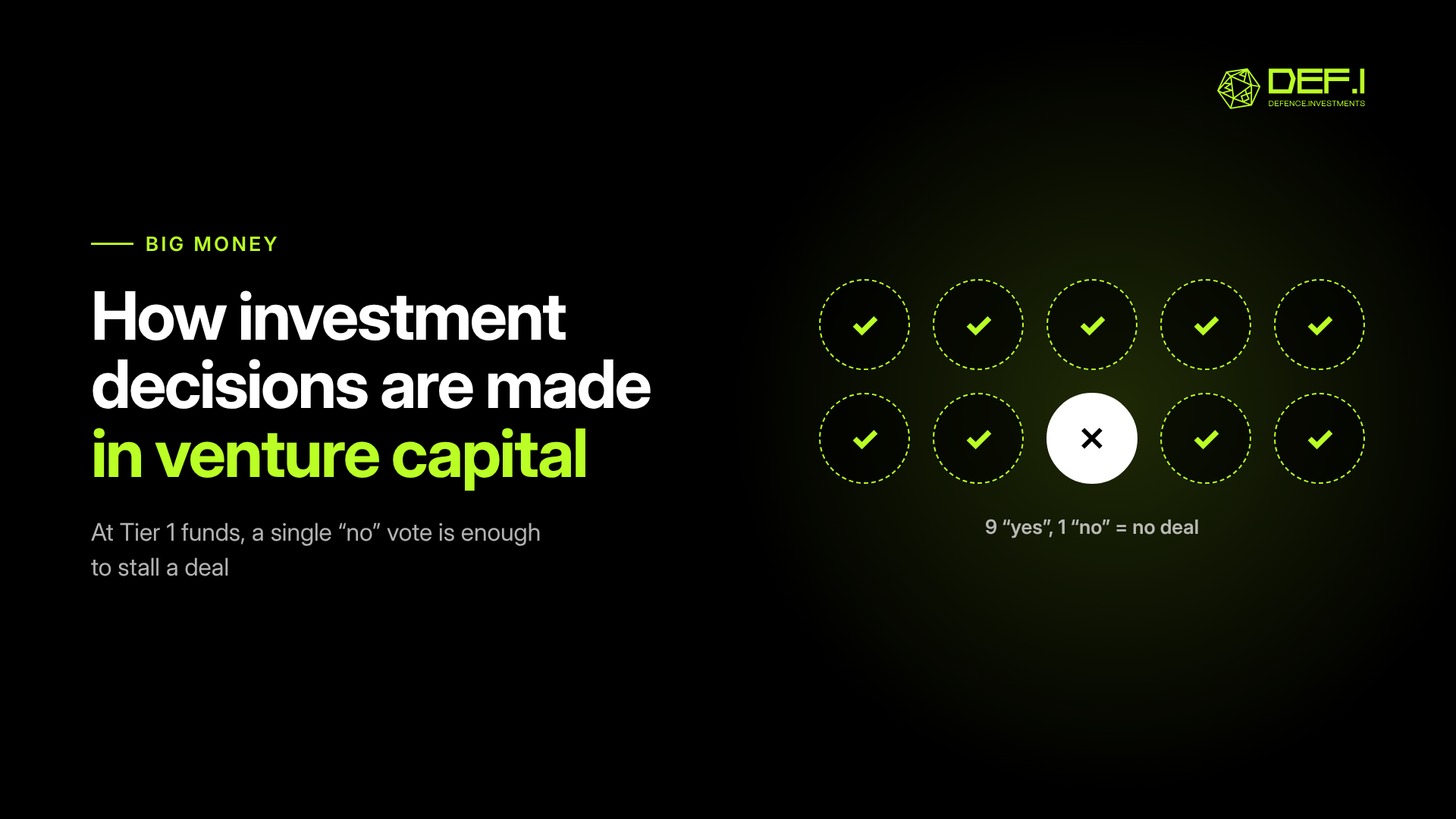
The main feature: at most Tier 1 funds, a single "no" vote is enough to block a deal. One managing partner out of ten said no - the deal does not go through, or it hangs.
It looks harsh, but the logic is clear. All managing partners - and there can be 5, 10 or 20 of them - put their own money into the fund. If any of them sees a risk the others do not notice, they have a real financial incentive to raise it.
The committee can meet on a single project several times. Sometimes they say "tighten this up, clarify that" - and you come back again. It is not a refusal, but it is not an approval either.
Some managing partners can invest without the committee - the ones who created the fund and whom the other partners trust unconditionally. If such a person saw something interesting in your project, the money can appear without the whole standard procedure. As I wrote above, networking and personal connections decide an incredible amount in this world.
Venture capital is deeply political. You need not only a good project - you need to be liked by the people who make the decision. It sounds unfair, but, unfortunately, in business there is no point looking for fairness, and it simply works this way. The likable guy who plays tennis, skis and tells good jokes is more likely to get the funding. You have to be one of them. Likeability wins, and there is a good deal of calculation in it.
After the Deal: A Seat on the Board
You got the investment. You think the story is over - but the next stage has begun, and it is just as important.
A managing partner (GP) joins your board of directors. Their job is to collect data, monitor the situation and make decisions from the investor's position. They are neither your enemy nor your friend. They are a person risking their own money who wants to understand what is going on.
This person sits on 8-12 company boards at once. So the management will not be hands-on - most likely it means a board meeting every quarter or half year, plus quarterly and annual reports. It is not heavy administrative pressure, but it is a serious responsibility: the company must reorganize so that the reports truly reflect progress rather than being adjusted after the fact.
A few things that get written into the terms at entry:
- The GP can block certain decisions.
- Shares cannot be sold to other investors without their consent.
- Founders will most likely be placed under vesting - they are obliged to stay in the company and work.
- The GP has access to all financial reports.
There is also the format of an "observer without voting rights" - the investor attends board meetings and collects information but does not vote. It is a compromise when the project does not want to give a vote and the investor accepts such terms.
Most of these restrictions are a normal working arrangement. It gets difficult in only one case: when the investor decides to "eat" the project - to gradually take over control through their board powers. Then the business turns into politics, and that is a serious problem. There is no point discussing it in this article: plenty of films have been made on the subject.
What a Founder Needs to Understand
This whole process is long, draining and unpredictable. You can go through the entire funnel, win over the managing partners, assemble a perfect due diligence package - and be turned down at the investment committee because one of the partners was in a bad mood. That is no exaggeration. That is reality.
That is exactly why fundraising is not a one-time action but ongoing work. Networking before the project. Traction before the money. Patience at every stage. And a very clear understanding of what you want from the investor and what they want from you - before signing, not after.
When you are offered terms, read everything about future rounds, voting rights and share buyback conditions. Whatever is not written down will be interpreted the way that suits the other side.
Need help preparing to raise investment? The Defence.Investments team can help with fundraising consulting and launching your project.
 0
0 2
2
 October 13, 2026






Comments 0