
Technical debt in an MVP: what it is, why it matters, and how to manage it
Contents
Technical debt is the future cost of addressing shortcuts that make a product harder to change. It affects feature delivery, service reliability, and a startup's spending. This article explains its different forms, assessment methods, and practical ways to keep an MVP manageable.
When planning MVP development, agree on acceptable shortcuts and essential requirements in advance. Validating demand can involve processing some requests manually. Payment security and access controls need attention from the first release.
What technical debt means in plain language
Technical debt accumulates when code makes subsequent changes harder. Suppose the same validation rule is copied into several modules. Updating that rule requires a developer to find every copy. A missed instance creates inconsistent behaviour.
Such a decision has both a remediation cost and a cost of continuing to work around it. Remediation includes revisiting the structure and checking the result. Ongoing costs include repeated changes, manual reconciliation, and investigations. These additional efforts show the effect on the business.
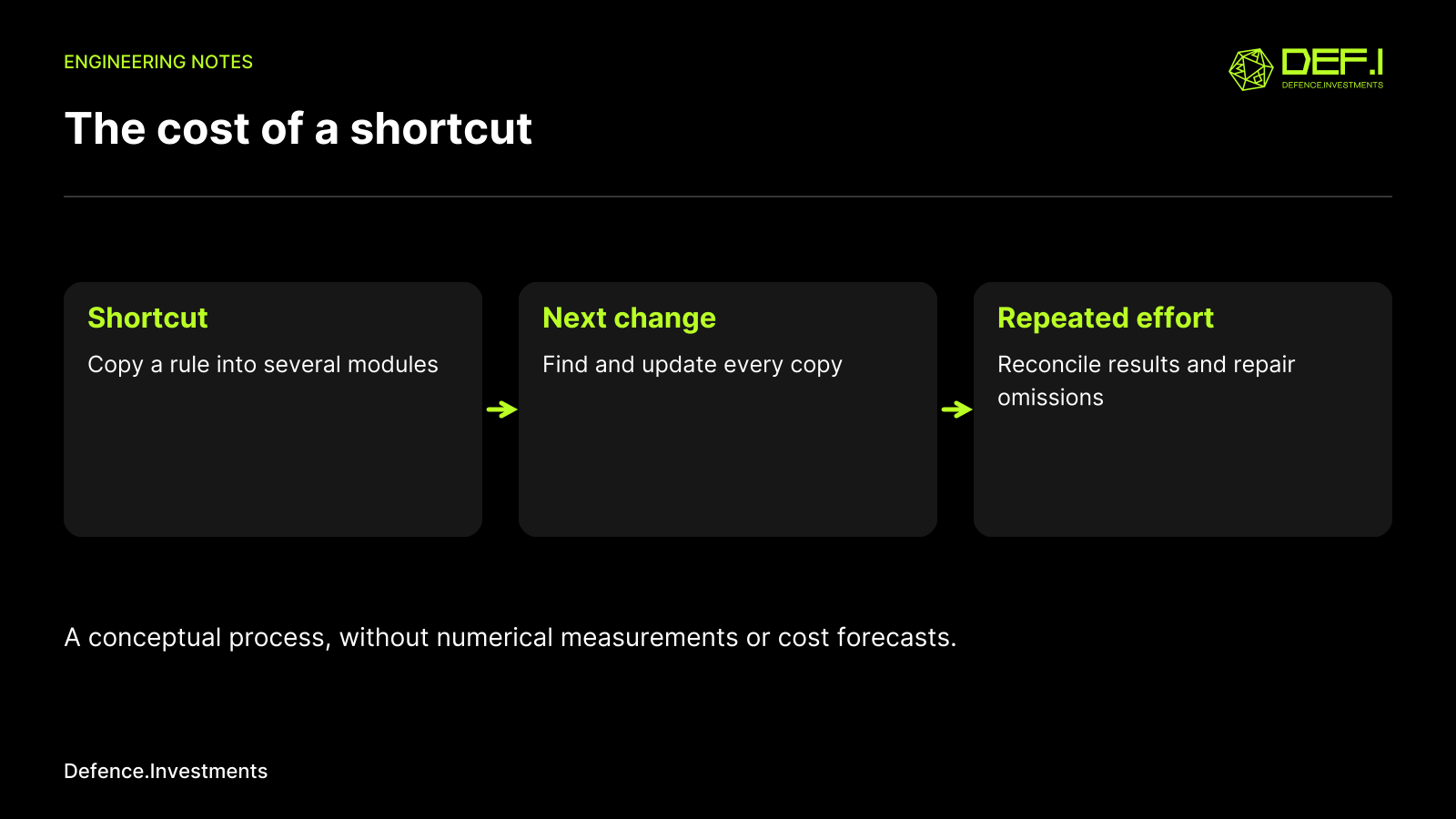
The diagram illustrates how additional work arises. It does not present measurements or forecast a rate of cost growth.
Where the term came from: Ward Cunningham's metaphor
Ward Cunningham used the debt metaphor in his 1992 report on the WyCash system. He described delivering an initial implementation quickly and revisiting it afterwards. An incomplete understanding of the problem domain gradually makes further changes harder.
The term helps engineers discuss architectural decisions with management. A shortcut can make it possible to test a hypothesis sooner. It also creates future work. Recording the scope, conditions for revisiting it, and an owner makes the trade-off visible.
How technical debt differs from bugs and old code
A bug is observable incorrect behaviour, such as applying a discount twice. Technical debt can exist while the output is correct: the calculation works, but changing it requires edits in several places.
Assess old code by its condition and role in the system. Age alone says little about maintenance cost. A codebase with clear checks can work for years. A newly written component can also be difficult to maintain.
Why technical debt appears during MVP development
An early startup has few confirmed requirements. The development team is testing its audience, payment flow, and demand for features. Decisions are made with incomplete information. The product's structure needs adjustment after the first customers arrive.
Debt builds up when temporary solutions are repeatedly reused. Manually importing a report becomes a daily responsibility. A quick file exchange becomes a dependency between services. The workaround remains after the original reason has disappeared.
Look for causes in the development process:
- temporary constraints are not recorded;
- deadlines are set without assessing dependencies;
- only the author checks a change;
- one person holds the knowledge of a critical module;
- the user journey changes while old logic remains.
Each cause calls for a suitable action. Documentation transfers knowledge, but cannot remove excessive coupling. First identify the specific activity that creates repeated costs.
Types of technical debt
Classifying debt by origin and location is useful. The first perspective explains how a decision was made. The second shows where to look for constraints and who can address them.
Deliberate and inadvertent debt: Fowler's quadrant
Martin Fowler's technical debt quadrant uses two dimensions: whether a decision is deliberate, and whether it is prudent or reckless. A conscious shortcut can be well considered or irresponsible. Inadvertent debt can reflect missing knowledge or learning gained through experience.
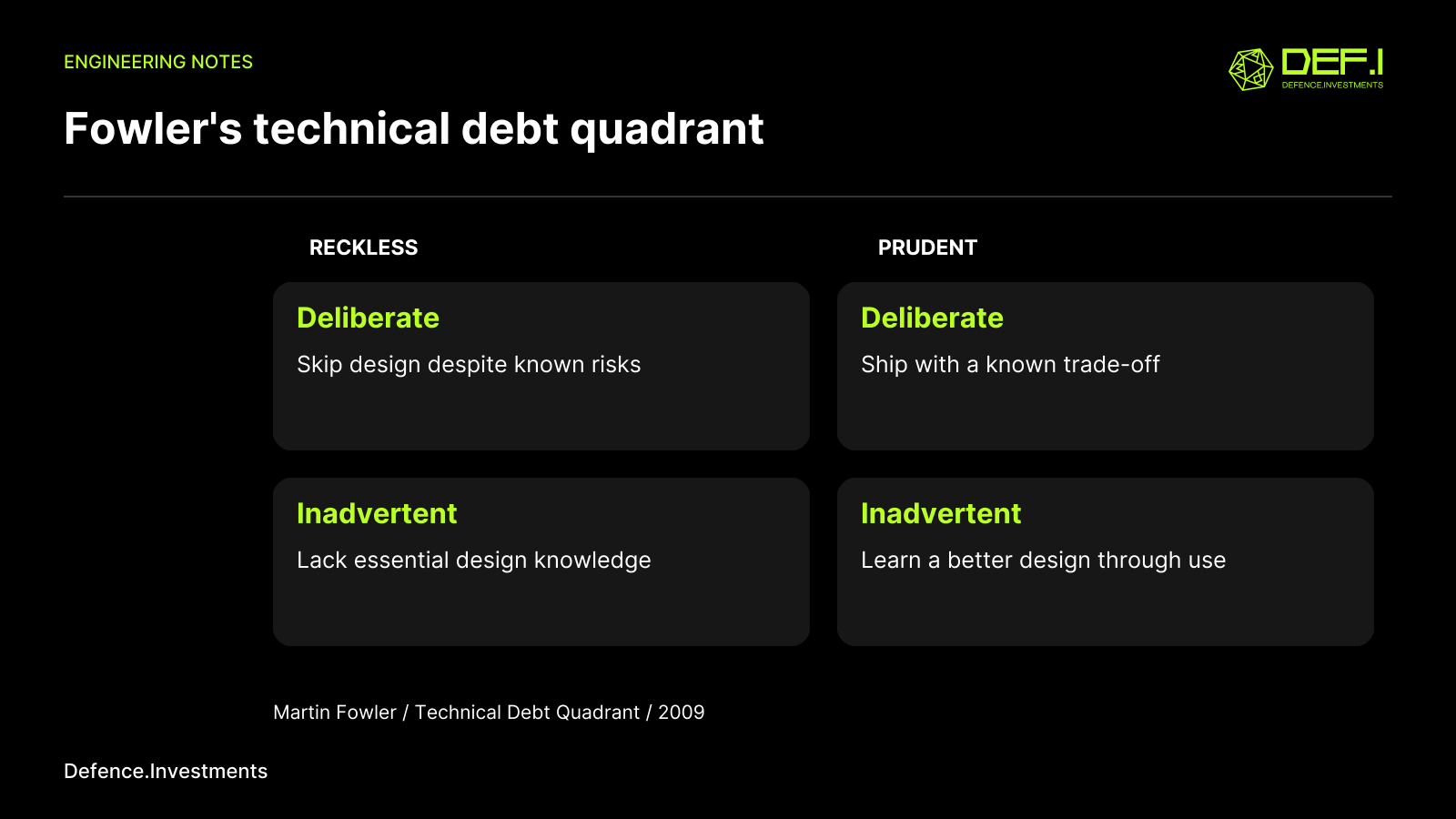
The four combinations describe how a decision arose. The classification helps guide the response.
Architectural, code, testing, infrastructure, and documentation debt
Grouping debt by area of responsibility helps plan the work. It becomes easier to involve the right people and verify the result. A single constraint may span several areas.
| Type | What it looks like | First action |
|---|---|---|
| Architectural | Changing one component requires coordinated releases elsewhere | Identify tight dependencies and module boundaries |
| Code | Logic is duplicated or processing rules are hard to follow | Simplify a frequently changed area |
| Testing | Each release requires lengthy manual checks | Record critical journeys and add checks |
| Infrastructure | Environments differ and deployment depends on manual commands | Describe configuration and reproducible deployment |
| Documentation | Onboarding requires constant explanations | Record the structure, constraints, and decisions |
Why technical debt is risky for a startup
The main risk is losing predictability. A sales plan depends on launching an integration. The integration requires changes to shared logic. The schedule slips, and the company has to postpone commitments to customers.
How debt slows feature delivery
Feature delivery includes understanding existing logic, making changes, and checking compatibility. When dependencies are unclear, an estimate may cover only part of this work. The remaining effort appears close to release.
Consider a hypothetical payment method linked to registration, reporting, and notifications. Adding another provider touches all those areas. A developer repeats checks that could otherwise run independently.
Signs that debt is getting out of control
Start investigating when recurring constraints affect important goals:
- similar tasks take progressively longer;
- fixes are regularly followed by related failures;
- changes are postponed because their consequences are unknown;
- a release depends on one specialist being available;
- manual reconciliation consumes a noticeable share of the work;
- estimates repeatedly change after work begins.
Collect dated examples and their causes. They reveal where the constraint persists. This makes the discussion more concrete than a general request to rewrite an inconvenient part of the software.
How to assess technical debt: metrics and tools
No universal number captures all technical debt. A tool sees only the part of the system available to it. Static analysis does not know how important a feature is to customers or how a manual operating process works.
In SonarQube's documentation, technical debt relates to estimated effort to remediate identified maintainability issues. It supports comparison when analysis settings remain consistent. It does not replace a complete engineering assessment.
| Metric | What to measure | Limitation |
|---|---|---|
| Remediation estimate in hours | Known work, expressed as an uncertainty range | Hidden dependencies can increase the estimate |
| Change Failure Rate | The share of deployments requiring immediate intervention | Use alongside a separate assessment of debt size |
| Test coverage | Lines or branches exercised during tests | High coverage does not prove that checks are useful |
| Regression cost | Effort spent repeating checks before release | Requires a consistent set of scenarios |
| Change lead time | Time from a committed change to production use | Both technical and organisational delays contribute |
The definition of Change Failure Rate follows DORA's metrics. Agree beforehand which events count as failed deployments. Otherwise, different people will record different cases.
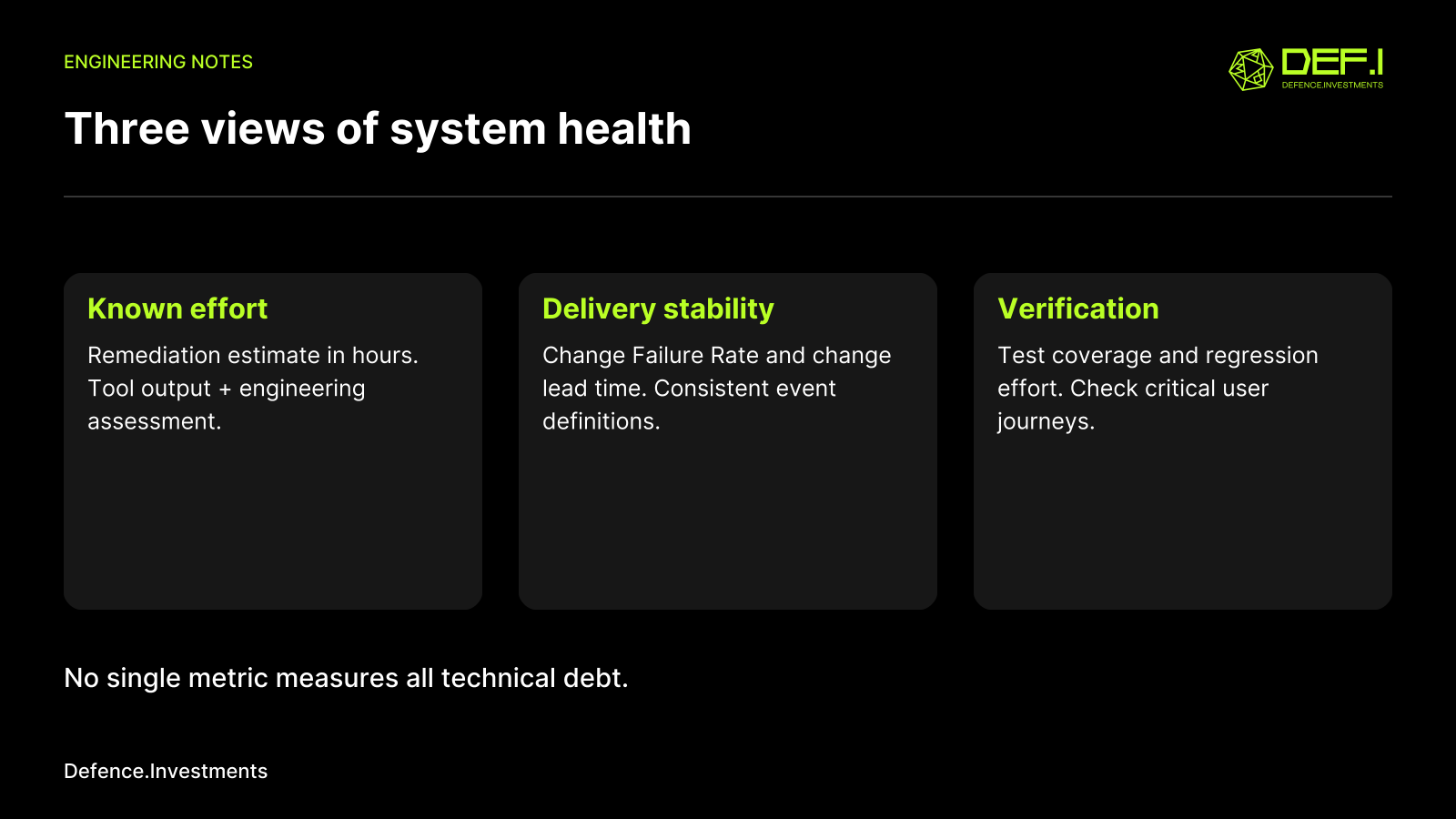
The metrics complement one another. No single metric describes the entire state of a product.
How to manage and pay down technical debt
Start with a shared list of observable constraints. “Improve the architecture” is too broad for planning. A useful entry explains which change is currently difficult and how an improvement can be verified.
Refactoring or rewriting code
Refactoring improves code quality while preserving observable behaviour. It is suitable for gradual work when the boundaries are clear. First protect current behaviour with checks and define a small scope.
A rewrite replaces an implementation and may require migration. It can be justified by confirmed limitations of the current solution. Include feature migration, compatibility, training, and transition support in the estimate.
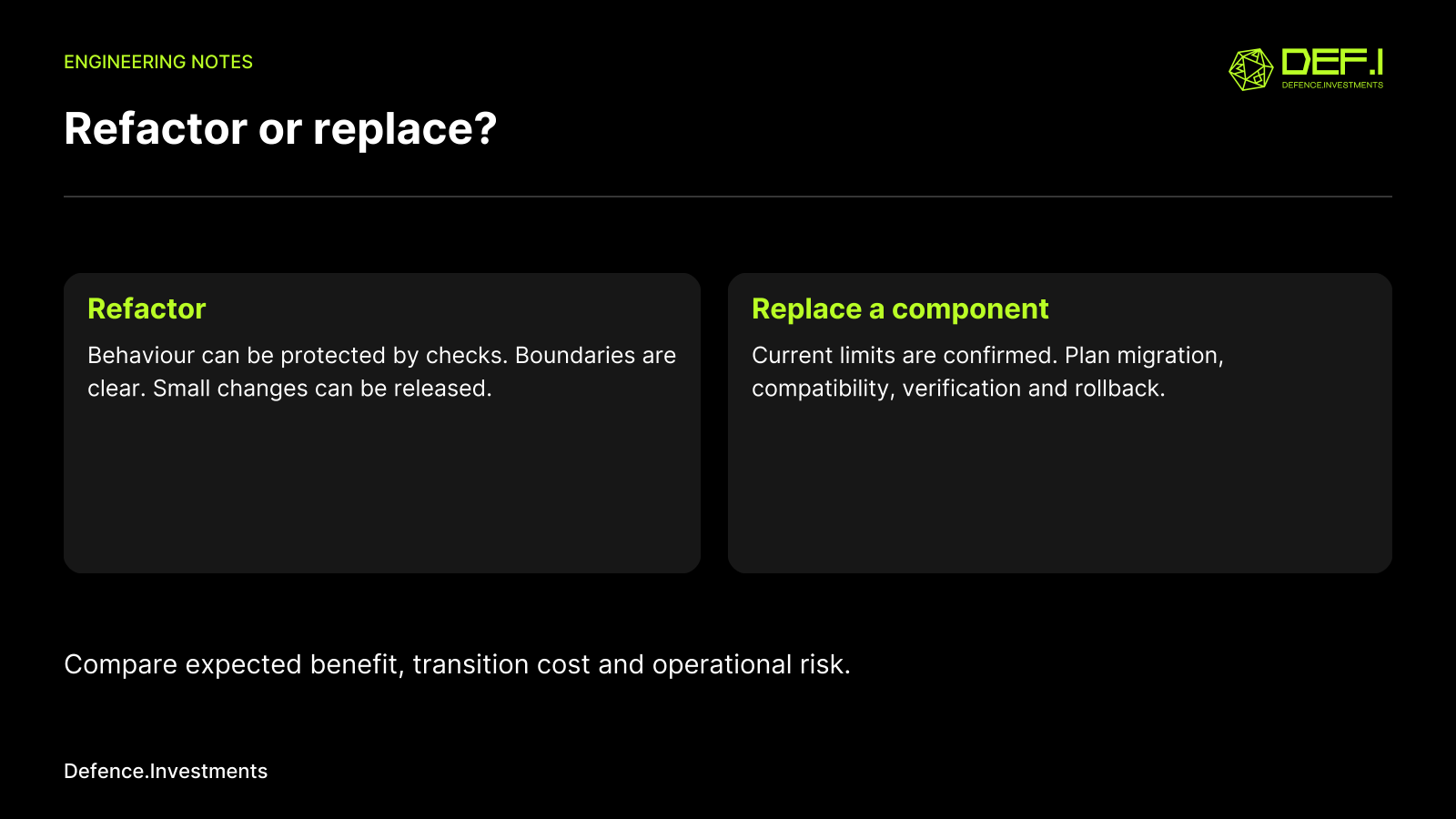
The choice depends on change boundaries, verifiable behaviour, and a safe transition.
Assess technical debt alongside growth plans. When preparing an MVP to scale, compare constraints with expected demand. Replacing a component should address a confirmed need.
Automated testing and code review
Automated testing reduces repeated manual work in stable scenarios. Start with registration, payment, access changes, and other critical operations for your platform. Choose checks based on actual business risks.
Peer review helps reveal dependencies and share knowledge. CI can run tests, vulnerability analysis, and agreed checks. A failed check should lead to a clear action.
Time for debt work in each sprint
There is no universal percentage of a sprint to allocate. The amount depends on risk, release plans, and the state of the platform. Select a constraint that affects the current goal, then estimate a feasible change.
A practical cycle is:
- Record the specific constraint and its consequences.
- Estimate remediation, verification, and rollback.
- Agree on priority with the product owner.
- Deliver a small, verifiable change.
- Compare the result with the starting point.
- Update the register of remaining constraints.
Regular review keeps the work manageable. Close a task based on its outcome. A changed internal structure alone does not demonstrate lower operating costs.
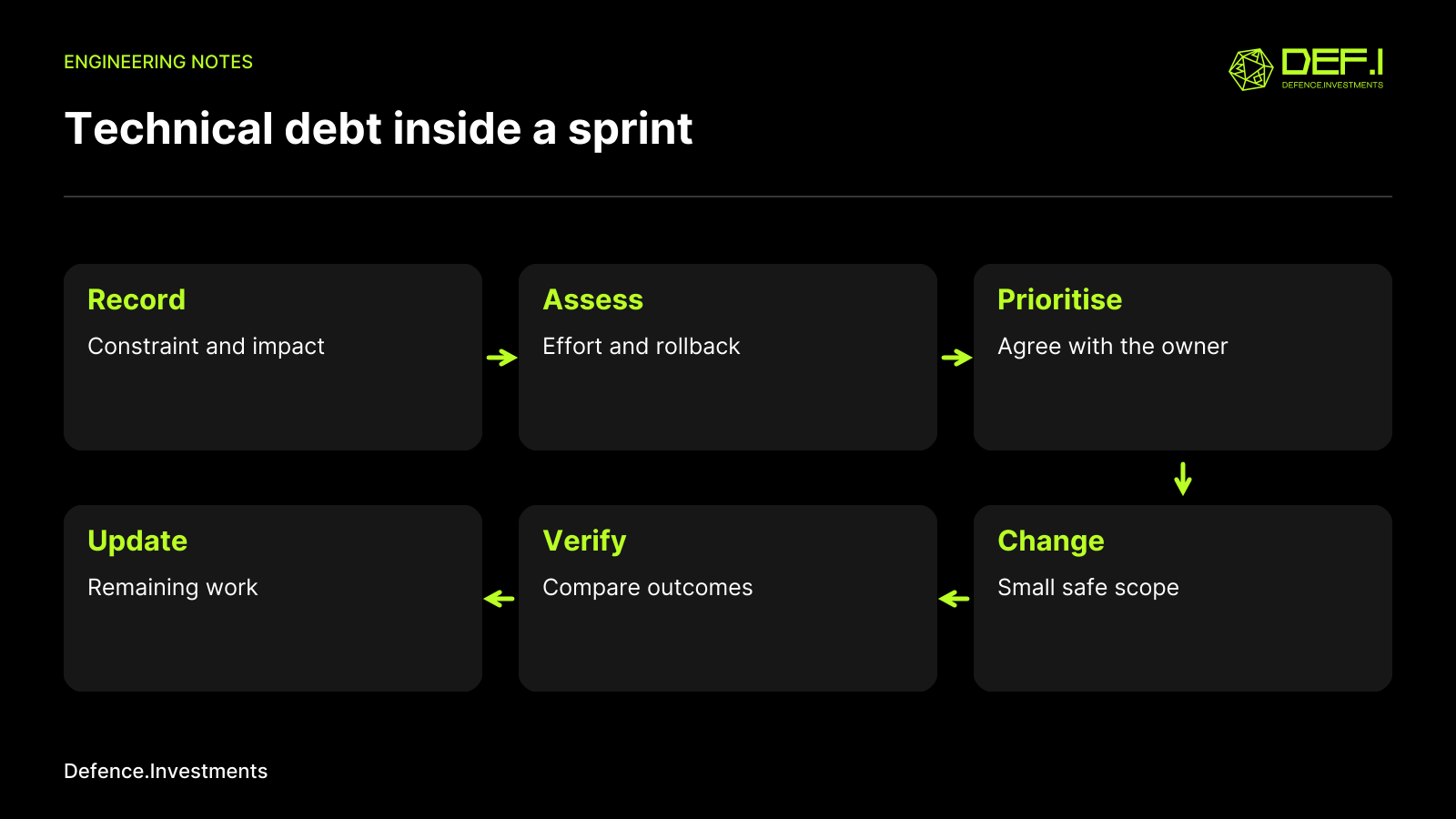
Each constraint moves through assessment, prioritisation, remediation, and outcome verification.
When technical debt is justified
A shortcut can be justified to test a hypothesis with a limited lifetime. For example, an infrequent request can be handled manually for a while. This establishes demand before automation is built.
Make the conditions explicit: expected benefit, acceptable consequences, an owner, and a review point. Specify the trigger for revisiting the decision, such as growing request volume, confirmed sales, or changing mandatory requirements.
How to limit technical debt in an MVP
Future changes cannot be eliminated. Small decisions with clear boundaries help reduce the risk. Choose maintained dependencies, record important assumptions, and make deployment reproducible.
When commissioning end-to-end startup development, agree on handing over the repository, access credentials, and documentation. Discuss which constraints will remain after the first version. This gives the next stage a clear starting point.
Before release, check the essential agreements:
- critical operations have acceptance criteria;
- access and infrastructure owners are known;
- environment configuration can be restored;
- data is protected and backups are provided;
- temporary shortcuts have recorded review conditions;
- the team understands how to roll back an unsuccessful change.
This checklist keeps constraints visible. Extend it using experience from the specific project. After launch, assess which limitations actually affect customers and support costs.
Frequently asked questions about technical debt
These questions help a founder and technical lead agree on initial actions and the limits of an assessment.
Is technical debt bad?
It means future costs and constraints. Assess a decision by the benefit gained and its consequences. A deliberate shortcut can accelerate demand validation. Repeatedly ignoring the consequences increases the risk of delays and failures.
How does technical debt differ from bugs?
A bug is incorrect software behaviour. Accumulated constraints make maintenance and change more difficult. One area can have both problems. Describe the behavioural error separately from the reason it is hard to fix.
How can technical debt be estimated in hours?
List specific tasks and estimate each as a range. Include investigation, implementation, testing, migration, and rollback. Compare the tool's figure with an engineering estimate. The total covers known work; hidden effort may be missing.
Is there a normal percentage of technical debt?
There is no universally safe percentage for every company. A ratio reported by an analysis tool depends on its rules. What matters for planning is how constraints affect specific goals. Compare your own periods using a consistent calculation method.
Does vibe coding increase technical debt?
Automatic generation can accelerate the introduction of unchecked decisions. Risk depends on understanding the output, requirements, verification, and maintenance ownership. Apply the same acceptance process to generated changes. Pay particular attention to access controls, dependencies, and data handling.
Where should repayment start?
Choose one frequently changed area that creates repeated effort. Record the symptoms and expected outcome. Add protective checks, make a limited improvement, and assess the effect. Then decide what to address next.
Constraints become manageable when their consequences and the work process are understood. Start with one limitation tied to the next goal. That provides a verifiable result and a basis for further product development.
 0
 2




 November 3, 2026






















Comments 0