X11 Case Study: Digital Platform for Investor Management
Brief description
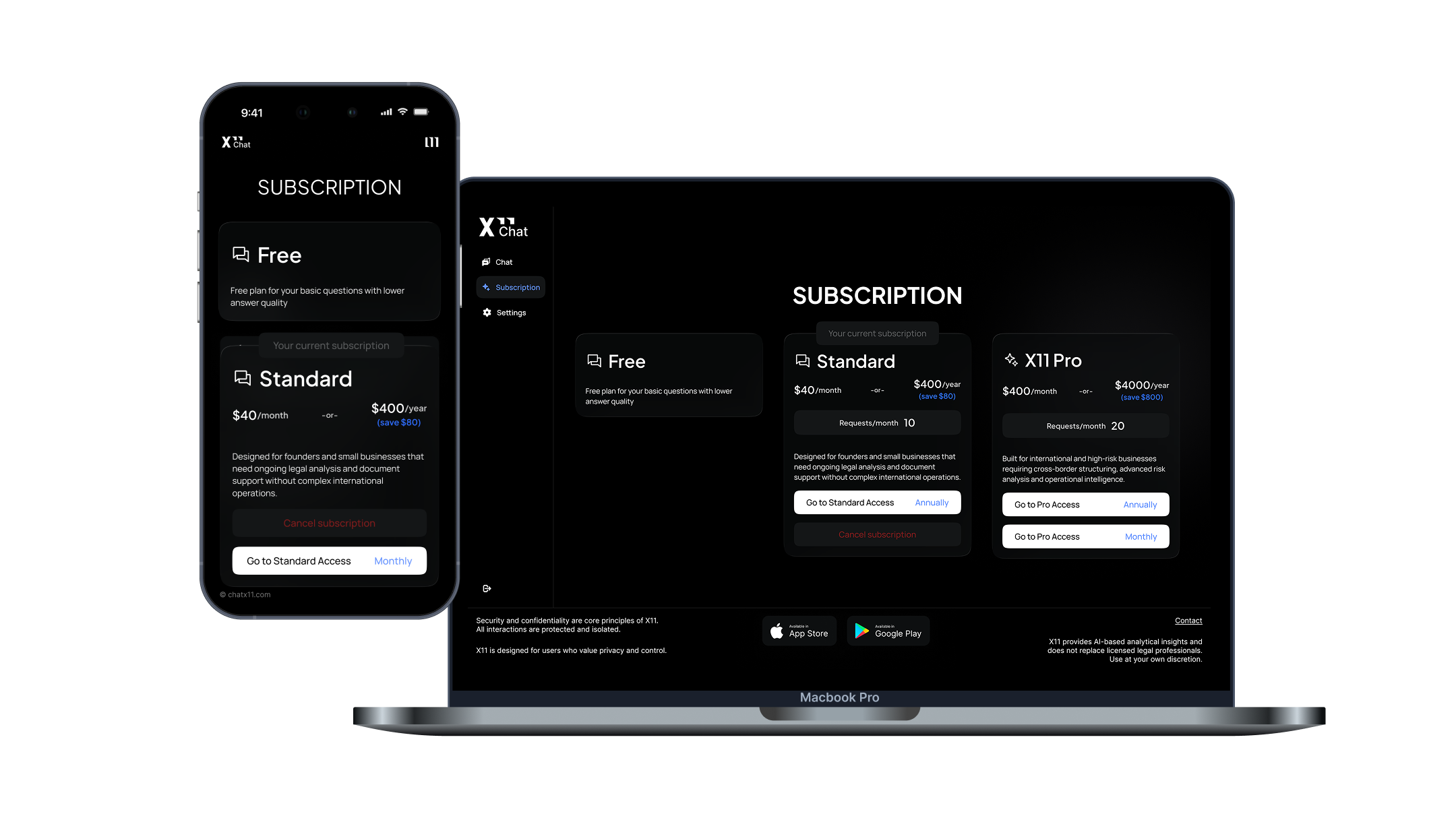
AI lawyer web service: an online legal consultant across jurisdictions powered by LLM, with its own knowledge base, subscriptions, and chat history.Task
Build a product that gives users fast legal answers across jurisdictions through a specialized AI assistant, with authorization, pricing plans, and saved inquiry history.About the project
We built a legal consultation service on top of AI model APIs. For the task we wrote a custom neuro-lawyer prompt and assembled a knowledge base for legal questions across jurisdictions. We delivered a full UI system with authorization, subscription plans, and stored user chat history.Business benefits
Features

Fast user registration via email or phone
Authorization and access to the personal account
Store and delete user inquiry history
Access to saved dialogues
Manage basic profile data
Messenger-style interface for talking to the AI lawyer
Send text legal questions
Attach files to an inquiry
Save full dialogue history in the personal account
Separate new and past consultations
Continue a previous dialogue without losing context
Understand the context of the user’s inquiry
Identify the legal problem from the message
Automatic clarifying questions
Collect missing information before forming an answer
Recognize legally significant entities: names, dates, organizations, amounts, statute articles, case circumstances
Form an answer using the user’s input
Configure AI rules through prompt engineering
Create basic legal consultation scenarios
Configure answer limits and structure
Build clarifying-question logic
Support a dialogue consultation scenario
Architecture prepared for a later move to a proprietary AI model
Build an internal legal document base
Search legislative materials inside the platform
Use the internal base as the priority data source
Work with codes, laws, regulations, and other normative materials
Structure prepared to expand with case law and legal doctrine
Upload user files into the chat
Pass files into processing within the consultation scenario
Use attached materials as extra inquiry context
Store files within a specific dialogue
Paid plans can be connected
Access-limiting logic by subscription prepared
Further user segmentation by pricing plans supported
Limits on inquiry count, features, or processing volume
Ability to connect a payment provider
Support for YooKassa, CloudPayments, Stripe, or similar solutions
Payment logic for subscriptions or individual consultations prepared
Payment status handling inside the platform
Technology stack
React Native + Expo — single codebase for iOS, Android, and Web
React 19 + TypeScript — modern type-safe frontend
Expo Router — file-based routing and navigation
TanStack React Query — caching, sync, and data updates
NativeWind (Tailwind CSS) — utility-first styling
React Hook Form — auth, registration, and settings forms
Axios + Orval — typed API client and OpenAPI codegen
ASP.NET Core 8.0 — server application foundation
ASP.NET Core Identity + JWT — authentication
Entity Framework Core 9.0.9 — ORM
Hangfire — background jobs
MailKit and MimeKit — email
MediatR — CQRS for queries and commands
Swashbuckle — OpenAPI/Swagger docs
Asp.Versioning — API versioning
AWS SDK — Amazon S3
Stripe.net — payments
OpenAI — artificial intelligence
PostgreSQL — primary database
Docker — containerization
Serilog — logging and monitoring