
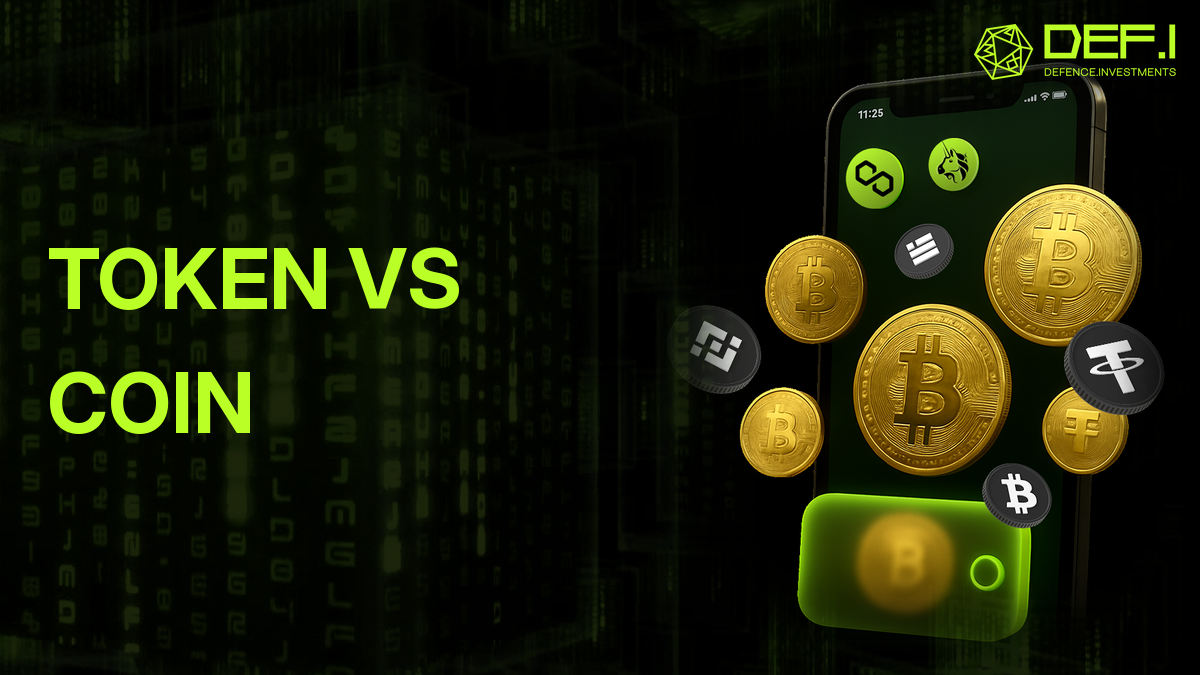
Token vs Coin: Clearing Up the Confusion
Contents
Coin and token get used almost as synonyms in crypto conversations. That's imprecise, and it causes real confusion. The difference between them is fundamental, and it defines how an asset exists both technically and legally.
Coin - What It Actually Is
A coin is the native asset of its own blockchain. It exists because that blockchain needs it to function.
Examples:
- Bitcoin (BTC) - the native coin of the Bitcoin network
- Ether (ETH) - the native coin of the Ethereum network
- SOL - the native coin of the Solana network
- BNB - the native coin of BNB Chain
Coins pay transaction fees (gas), secure the network through staking and block validation, and keep the chain running. Without its native coin, a blockchain doesn't function - it's the network's fuel.
Token - What It Actually Is
A token exists on top of someone else's blockchain. It has no infrastructure of its own - it lives inside a smart contract deployed on another blockchain's network.
Examples:
- USDT (Tether) - a token that exists across several networks: Ethereum, Tron, BNB Chain, and others
- UNI (Uniswap) - the governance token of the Uniswap protocol, living on Ethereum
- LINK (Chainlink) - the token behind the oracle service, also on Ethereum
- Most ICO/IEO tokens - virtually all of them live on Ethereum or BNB Chain
When you send USDT over the Ethereum network, you pay the transaction fee in ETH, not USDT. That's because ETH is the network's coin, and USDT is only a token running on top of it.
Key Differences
| Coin | Token | |
|---|---|---|
| Own network | Yes | No |
| Technology | Native protocol | Smart contract |
| Purpose | Network operation, fees | Utility, governance, assets |
| Examples | BTC, ETH, SOL, BNB | USDT, UNI, LINK, SHIB |
Why This Matters in Practice
First, working with tokens always requires holding the network's native coin to cover fees. Want to send USDT over Ethereum? Hold ETH. No ETH, no transaction.
Second, a single token can exist on multiple networks at once. USDT exists on Ethereum, on Tron, and on Solana. These are different versions of the token, living in different smart contracts. Sending USDT from one network into a wallet on another network means losing the funds.
Third, creating a token is significantly simpler and cheaper than launching an entire blockchain. That's exactly why most projects issue tokens rather than coins.
The Gray Area: Is ETH a Coin or a Token?
ETH is a coin. But ERC-20 tokens technically "live" on Ethereum too. Ethereum is both a blockchain and a virtual machine for executing smart contracts. ETH is the native asset of that machine. Everything else running on it is a token.
Frequently Asked Questions
Can a token be sent without the network's native coin?
No. The fee for any transaction on a network - including a token transfer - is always paid in that network's native coin. Without ETH in the wallet, a USDT transfer over Ethereum won't go through.
Why does USDT have multiple versions?
Because USDT is issued as a token on several networks at once - Ethereum, Tron, BNB Chain, and others. These are independent smart contracts, not directly connected to each other.
Which is cheaper to create - a coin or a token?
A token. Launching your own blockchain with a native coin means building and securing an entire network infrastructure. A token deploys through a ready-made smart contract on a blockchain that already exists.
Is ETH a coin or a token?
A coin. ETH is the native asset of the Ethereum network, used to pay gas. ERC-20 tokens exist on top of Ethereum, but ETH itself is not a token.
Bottom Line
A coin is a blockchain's native asset - the network's fuel. A token is an asset created on top of an existing blockchain through a smart contract. The practical takeaway: when working with tokens, always keep the native coin of that network in your wallet.
If you're planning to launch your own token and need to work through its economics, Defence.Investments offers tokenomics and whitepaper services.
 0
0 1
1
 October 1, 2026








Comments 0