Blockchain Testament Case Study: Crypto Asset Inheritance Through Web3
Brief description
Web3 service for crypto asset inheritanceTask
Build a platform where the owner predefines heirs and shares, and asset transfer is triggered by a confirmed event through protected voting logic, a notary, or a quorum.About the project
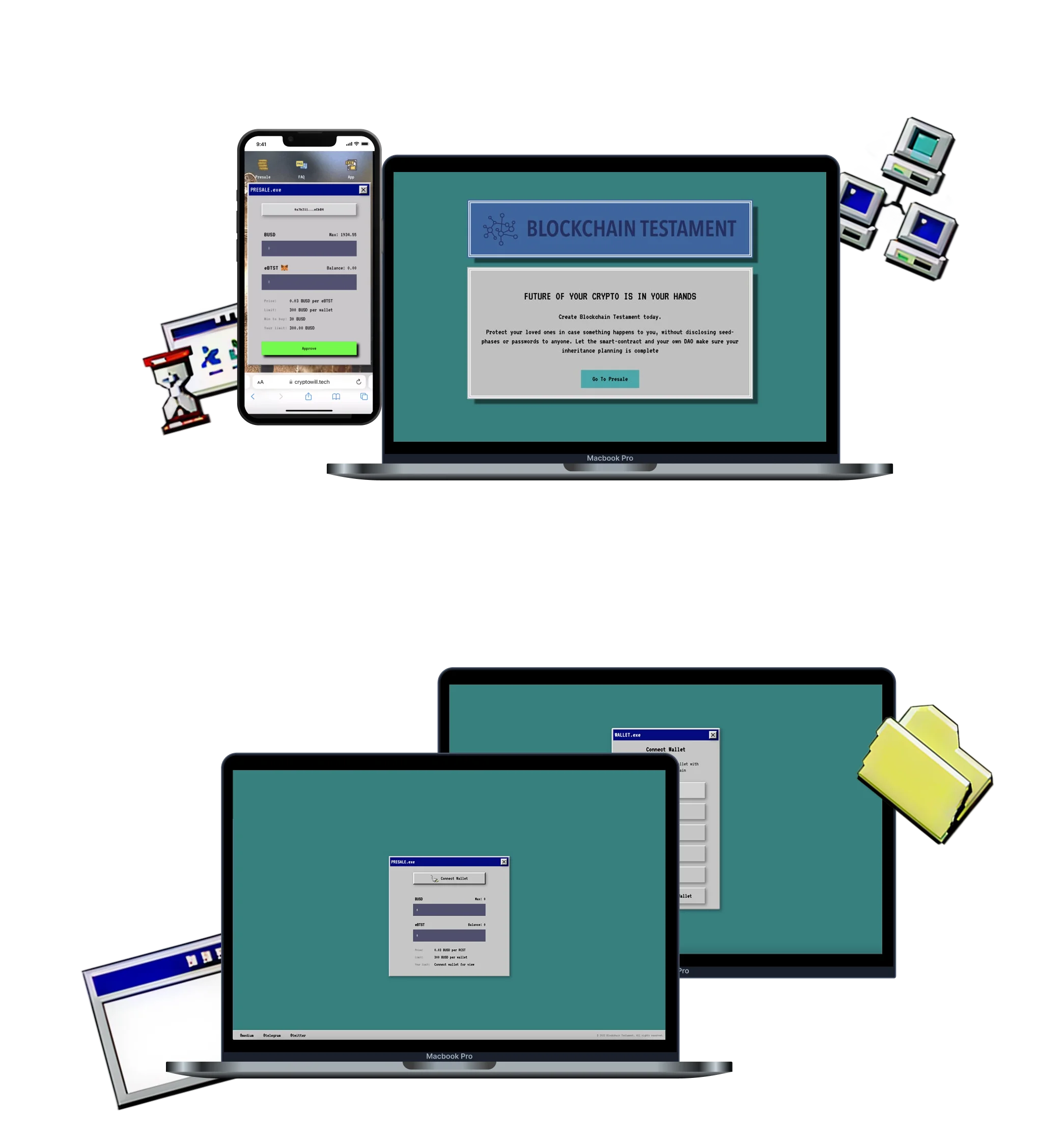
Blockchain Testament is a Web3 platform for creating and executing a digital will for crypto assets. The user defines inheritance rules in advance, and execution follows transparent on-chain logic via a smart contract: who receives the assets, in what shares, and under which conditions the transfer procedure starts.The core product idea: crypto asset inheritance without informal agreements and intermediaries, where rules are set in advance and cannot be changed retroactively.Business benefits
Features

Creating a will from the user’s wallet — user address (msg.sender)
Entering trustee and heir wallet addresses and percentage distribution for each
List of currencies to transfer to heirs
Quorum parameters required for fund distribution
Enable/disable holding funds on the contract for X period after voting (boolean)
Voting parameters: participant limits, fee settings, and recipient address
Specifying heir addresses
Share distribution in percentages
Logic for changing and editing the will from the creator’s account
Heirs and trustees do not see the total amount of assets
Ability to vote by will ID
Quorum composition and conditions are set only by the will owner
Possible only after the quorum has passed
Hold period before receiving funds according to regional legislation
Add validators, trustees, and heirs
Remove validators, trustees, and heirs
Change validators (% share), trustees (% share), quorum size, inherited tokens, DAO name
Requires specifying the insurance/will id; only a validator can start
Notary checks related to death confirmation are added
Adding a quorum of those who confirm the event
Storage of will data
Email for notifications
Automation of payment/status control and user notifications
A freemium model is built into the smart contract: some capabilities are free up to certain limits
When limits are exceeded, paid mode is enabled
Subscription options by period (1 month, 3 months (quarter), 6 months, 1 year)
Lifetime subscription — a one-time payment instead of recurring charges
Ability to pay for a lifetime subscription with BT tokens